
What Sontag Couldn’t See
And why I never recommend "On Photography."

Three times this week, I have encountered a reference to Susan Sontag’s On Photography. Three times I have smiled at being told something I already know. I have a background in philosophy. And art history. And considerable experience making art with a camera. And I wonder why this book, of all the critical books, journal and magazine articles on photography, would be considered an important text in the field? I am genuinely puzzled. I ask myself: did this person read the same book I did?
Because the book I read is not primarily about photography, it’s about Susan Sontag’s anxieties. And the difference matters, especially to Diane Arbus, who, due to this book, has been misread and misrepresented for fifty years by Sontag's attacks to promote her ideas and career. Just reading Sontag’s comments about Arbus’s death, you have to realize there is something wrong here. Some unexplained animus.
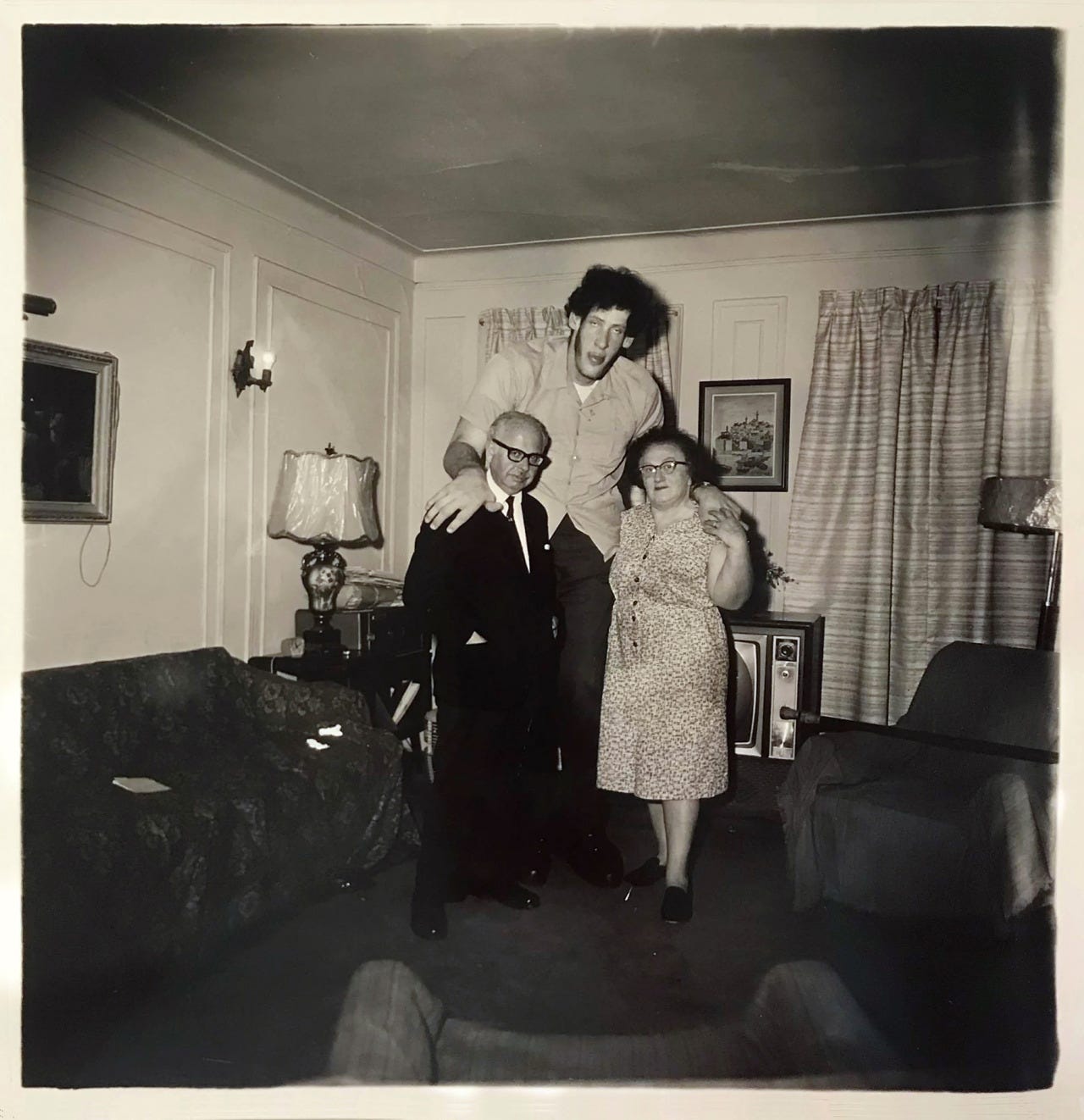
Stand in a room full of Arbus photographs and watch what happens. I’ve done that a few times. People slow down. They lean in and look closely. The line of viewers moves so slowly. They talk to each other in low voices. Not the polite murmur of people engaging in the act of just appreciation, but something more, recognition. In front of the famous photograph of Eddie Carmel, the “Jewish giant,” with his parents in their Bronx apartment, you hear people notice the same thing. He is crouching. Bending himself almost in half to fit, literally, into his parents’ world. His parents stand physically leaning against him. He looks somewhere past the camera. The room in the photograph is small, ordinary and full of love. It is a home, nothing more than a very typical home. These are people who struggle with something and continue to be who they are, proudly, every day.
This is not what Susan Sontag told us we would find.
Sontag’s essay in On Photography, published in 1977 and never quite out of print since, may be one of the more consequential misreadings in modern art criticism. Sontag described Arbus’s subjects as “pathetic, pitiable, as well as repulsive.” She argued that the photographs were built on distance and privilege, as if she wasn’t the one focused on being privileged and special, that these photos turned human difference into spectacle, and that the viewer was being invited to stare. The argument was stated not as an interpretation, but as a verdict. Arbus is guilty of everything, it would seem. Sontag did not leave much room for other readings. She rarely did in her writing.
Listening to the people standing in front of Eddie Carmel I note they did not get the memo. They used words like noble. They talked about community, about pride, about the way Arbus’s subjects, many of whom called themselves freaks, meant it as solidarity, as a kind of joyful claim on the word, seemed to be winning something. Winning on their own terms. Looking back at the camera, and through it at us, with a composure that made the viewer the uncertain party in the exchange.
That gap, between what Sontag said the photographs were doing and what people actually feel and express when they stand in front of them, is not a minor discrepancy. It’s the whole question.
Arbus did not photograph strangers. That is the first thing her biography makes clear, and it is the thing Sontag’s essay most conspicuously ignores. She spent weeks, sometimes months, building relationships with the people she photographed. Some subjects she returned to for years. They knew her. Many of them directed their own image, chose how to stand, how to look, and what to wear. The woman with the pearl necklace and the sash. The identical twins in matching dresses. The man at home in curlers. These were not ambushes. They were collaborations. If you lived in NY, you might remember hearing, “We’re here, we’re queer, get used to it,” a famous LGBTQ+ rights chant and slogan popularized by the activist group Queer Nation in the early 1990s. It was used to assert the presence and visibility of LGBTQ+ people in public life, demanding acceptance and challenging heteronormative societal norms. Starting with simple presence. That’s what I feel looking at these photos.
What these photographs give their subjects, consistently, is presence. Not pathos. Not pity. The people in Arbus’s portraits look back at you with full self-possession, sometimes with humour, sometimes with pride, and sometimes with a directness that borders on confrontation. They are not victims of the camera. If anything, they seem more comfortable in front of it than most of us would be.
To read this as exploitation requires overlooking a great deal of what the photographs actually show. It’s in the range of writing a book on photography and overlooking including any photos.
The literary biographer Carl Rollyson, who has studied Sontag’s career in depth and written extensively about her public intellectual persona, has observed something striking about On Photography’s reception. Students and general readers love it. Working photographers, the people who actually practice the medium, largely do not. Rollyson has noted, in interviews and public discussions of his work, that he has been unable to identify a serious practitioner who regards the book as either accurate or useful. Richard Avedon, not a minor figure, reportedly told the photographer Peter Hujar that he had come to think of Sontag as, in some sense, the enemy. Hujar’s long friendship with Sontag ended when On Photography was published.
This is not the reception history of a book that got photography right. Rollyson’s work is not always easy to locate through standard academic channels, but he maintains an active website and has discussed his conclusions in a series of accessible video conversations, both of which are findable by searching his name. For anyone who wants the documented record of Sontag’s life and intellectual career examined without deference, he is a great place to start.
What Rollyson’s work makes visible is the mechanism by which Sontag’s authority was constructed and maintained. She wrote in the New York Review of Books. She moved through the most prestigious literary institutions of her era. Her prose was elegant and assertive and fearless in its generalizations. In the intellectual culture of the 1960s and 70s, this combination: the right venues, the right confidence, the right enemies, could establish a reputation that specialists in a given field would spend decades trying to dislodge. By the time photographers pushed back, the book was already canonical.
Rollyson has also documented the more personal dimension of Sontag’s relationship with photography and with photographers. Not exactly evidence that would be accepted in court, but it is necessary to make a judgment about what, emotionally, was going on with Sontag’s issue with Arbus.
For many years, Sontag was in a relationship with Annie Leibovitz, one of the most celebrated photographers of the twentieth century. Leibovitz, by her own account and those of biographers including Benjamin Moser, spent nearly eight million dollars supporting Sontag. I still don’t understand that calculation, but I get the point. In return, Sontag was at times dismissive of Leibovitz’s work in public. Belittling her photography in front of others, treating her professional achievements as something less than serious art. The woman who wrote so confidently about the ethics of the photographic gaze, about exploitation and distance and the misuse of other human beings, conducted herself toward her own photographer with a contempt that is, as the record now makes plain, rather difficult to read about or understand. Draw your own conclusions. The evidence is there.
The critic and photographer Teju Cole has also written about the ethics of image-making with a clarity that cuts through most of the theoretical noise on the subject. For Cole, the ethical question is neither complicated nor abstract. It is about attention. Did the photographer stop? Did they look, and keep looking? Did they allow the subject to be fully present, not as an illustration, not as mere evidence, but as a human being whose particularity deserves recognition? The ethics live not in any theory of the camera, but in the quality of presence the photographer brings to the encounter. Cole practices what he argues; his photographs and his critical writing are inseparable from this principle. His essay collection, Known and Strange Things, is a place to start looking for an alternative way of approaching photography.
There is another, deeper, problem with Sontag’s framework, and it runs beneath everything she wrote about photography. She believed, at some level, in the old folk anxiety about cameras. That cameras take something from their subjects. Steal a piece of them. Diminish or consume. It is a feeling as old as photography itself. But as a general theory of the medium, it is difficult to sustain. A photograph is less like a theft than a kind of contract between photographer, subject, and viewer, in which the subject determines, consciously or not, the terms of their appearance. Arbus understood this. Her subjects were not victims of the camera. They were parties to the agreement, and most of them knew exactly what they were signing. What they gave the viewer was not their vulnerability. It was their self-possession. Sontag, who reduced all photography to a single anxious category, never saw the transaction for what it was. She was too busy worrying about the camera to notice what the people in front of it were actually doing.
None of this would matter if On Photograph were simply a minor period piece. But it isn’t. It is still assigned in universities. (Often editions with photos included, but not photos selected by Sontag.) It is still cited as authoritative. Students still read Sontag’s verdict on Arbus before they have had a chance to stand in a room full of her photos and form their own response.
The conversation around Arbus has shifted significantly in recent decades. Scholars have documented her working methods, her relationships with subjects, and the deliberate and often playful self-presentation of the people she photographed. The work is now widely understood as one of the major achievements in twentieth-century portraiture, not despite the directness of its gaze, but because of it. Arbus looked at people others looked away from. She gave them the camera’s full attention. They gave it back. Sontag looked at the same photographs and saw exploitation. What this tells us about Arbus is, at this point, very little. What it tells us about Sontag is a different matter. Read the critics, read the photographers’ words, then don’t forget to go look at the work. In the past year the greatest pleasure in photography for me is seeing the actual prints of some of my Japanese favourites. In the gap between what you are told to see and what you actually see is where your own thinking begins.
CODA:
Finally, a couple of little things: None of this excuses the rude street photographer who shoves their camera in someone’s face, takes a shot with flash, and walks away with their smirk on, or those who proudly present images on Facebook/Instagram of homeless people in distress as if they have taken a wildlife photo. Nope. Another note, I think there is a tangible difference in viewing Arbus’s images on a gallery wall, with people around you, and flipping through them in a book of photos. In the books, there are just too many things to look at and flipping the page is too easy, but that’s a topic for another time. The lesson is not complicated.
Image Credits and Fair Use
Images are reproduced here for purposes of criticism, commentary, and scholarship under principles of fair use (U.S.) and fair dealing (Canada, UK, and Europe). Copyright remains with the respective artists, photographers, estates, or rights holders. If you are a rights holder and would like an image credited differently or removed, please contact me and it will be addressed promptly.
_________________________________________
Thanks for reading. There were just too many mentions of “On Photography” the past week or so to ignore it. Your comments would be welcome. You can really help me out by subscribing. There are no fees. Just a request that you take a minute and share my writing, recommend it on Substack and elsewhere, and Re-stack it. Repost. Comment.
this is your first post read by me. you got yourself a subscriber
I get what you're saying, but all in all, this seemed to me to be an unfair attack on the artist, and still seems that way. There are just better, less aggressive and personalized places to engage in a discussion about ethics in photography than Sontag. Reading what Sontag said about the suicide....it's just a bit much.