
The Wall Above the Table
Beauty and Transgression

In 1990, a museum director in Cincinnati was arrested for showing photographs. The photographs were beautiful. That was the problem.
It was Monday, the Fifth of July, 1982, and I had just given a dinner for people with AIDS at the Middle Collegiate Church on East 4th Street, where I was a minister. I was freshly graduated from Union Theological Seminary. The Orpheum Theatre was on Second Avenue, around the corner, and Little Shop of Horrors had just opened there, and for months before that, the rehearsals had been happening in the practice room across from my office. The music and the voices came through the wall while I worked. The Collegiate Church was always noisy and full of people you didn’t quite recognize. There were three floors of rehearsal spaces, constant performances, artists, actors, and musicians moving through at all hours. It was at a focal point of the East Village. This was when the neighbourhood was still cheap enough for artists and a recent small wave of immigrants from Ireland. Across the street, at the Kiev, I sometimes shared a table next to Allen Ginsberg, who off and on lived up somewhere around 12th street. My days were full with meetings, writing, reading, phone calls and visiting people in the neighborhood. But something was beginning to happen that nobody had prepared for. There was a dark cloud coming.
Two young men came to the dinner together. David Grubb, a landscape painter, and Dennis Embry, an actor and playwright, who had until a year ago been working in off-Broadway shows and busy getting his own plays read. Earlier that day, Dennis had called the church asking if there was a dinner that night. He said he would be late because he had trouble walking. We sent a cab to pick him up. I met them both at the table in the corner that night. We had dinner, there was live music, something easy to arrange in this place, and after dinner, we sent people off with a bag of groceries. I sent Dennis home by cab with two bags; he seemed very thin.
The next week, David and Dennis came by again, and David suggested I come to Park Slope to see his studio, where he lived. I think we took the 6 train from Astor Place and somehow got to the Bergen Street. Somewhere, we switched to the IRT Brooklyn line. I was lost, and a bit concerned because he said he was a landscape painter, and I was an abstract painter. I was expecting to be less than impressed. I was impressed.
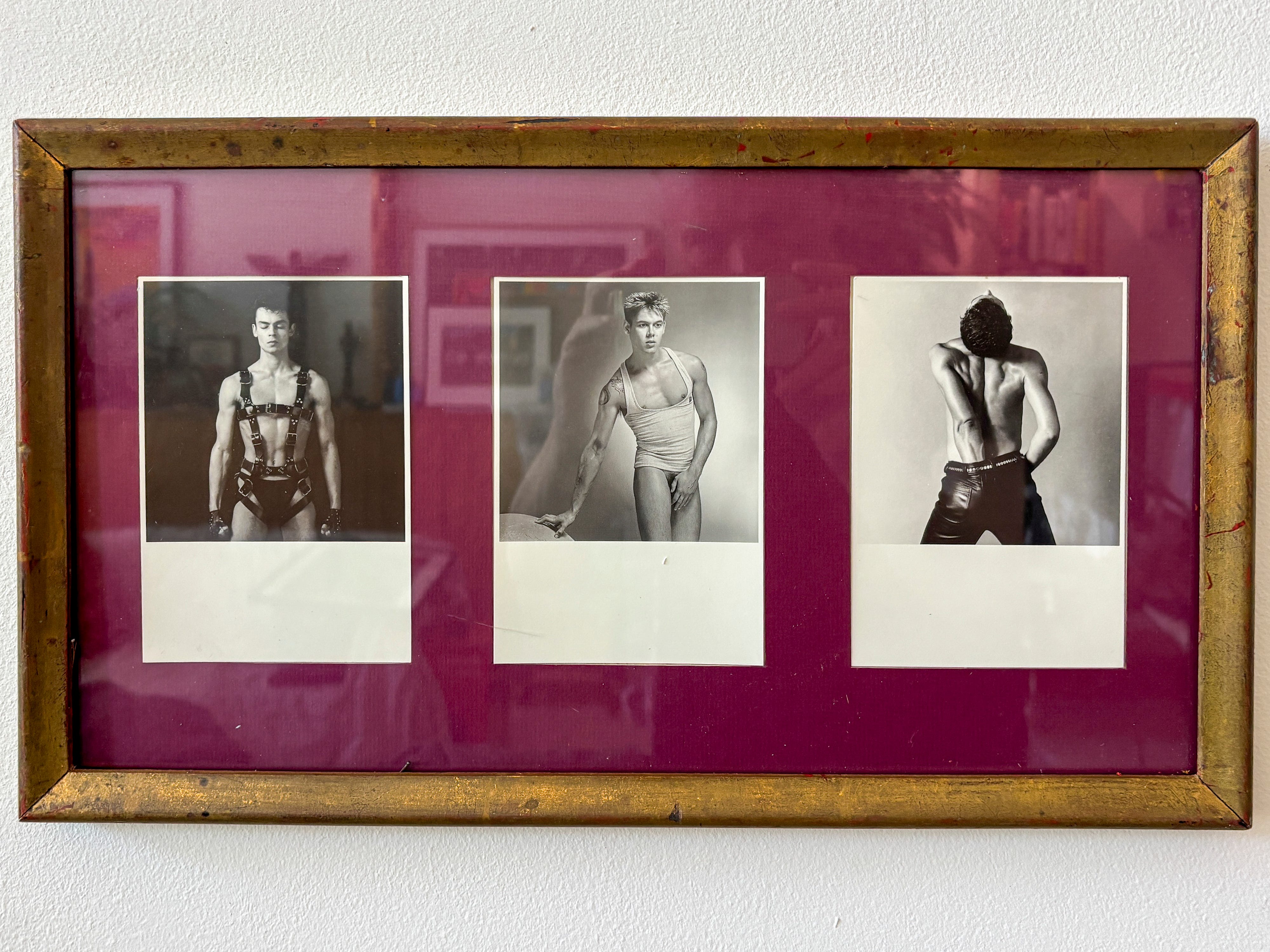
It was a neighborhood of brownstones that in 1982 was still becoming what it would eventually be. His apartment was on Union Street between Prospect Park and Seventh Avenue. 747 Union. The kitchen had a table. Above the table, in a single wide frame of dark wood, gold paint lightly applied, and a burgundy mat, were three black and white photographs, each approximately the size of a postcard.
The left photograph showed a man from approximately the waist up, shot straight on. He was wearing a leather harness, the kind that crosses the chest in a specific geometry, two straps from the shoulders meeting a horizontal band across the sternum, the whole construction fitted to the body with precision. His face was not in the frame. The photograph ended at the jaw. What remained was the body, symmetrical, the harness sitting on it with the ease of clothing worn by someone accustomed to wearing it. The light came from slightly above and in front, casting the musculature of the chest and shoulders into a modest relief. The print was dark, the background a flat black, the body emerging from it a clear fact, almost documentary in tone.
The centre photograph showed a man full-length, standing, in a white tank top and brief underwear. He was leaning slightly, the weight on one leg, the other knee bent, one arm hanging loose at his side. His face was visible, looking directly at the camera, not smiling, not performing. His body had the specific quality of a dancer’s body, which is a body that knows at all times where it is in space. The light here was softer, coming from the side, and the white of the tank top held it differently than the dark leather of the first photograph, glowing slightly against a grey background. He looked like someone who had decided some time ago who he was and had not revisited the question.
The right photograph was shot from behind. A man from the waist up, head turned slightly to one side, his back to the camera. He was wearing black leather pants, low on the hips, and above the waistband, the back was bare. The light fell across the musculature of the shoulders and the long line of the spine in a way that was precise and deliberate, finding the form the way a draftsman finds a form, with attention to where one plane meets another. The back of the head, the dark hair, the slight turn. That was all. It was enough. The images were imbued with confidence that young people of that age have more than enough of.
I stood in that kitchen in Park Slope and looked at those three photographs for a while. I did not say anything immediately. I was not sure, at first, what I was responding to. I had not, before that visit, hung anything on my own walls that was this direct. This set of images presents the body, the male body, the gay male body in its specific iconography, without apology and without distance
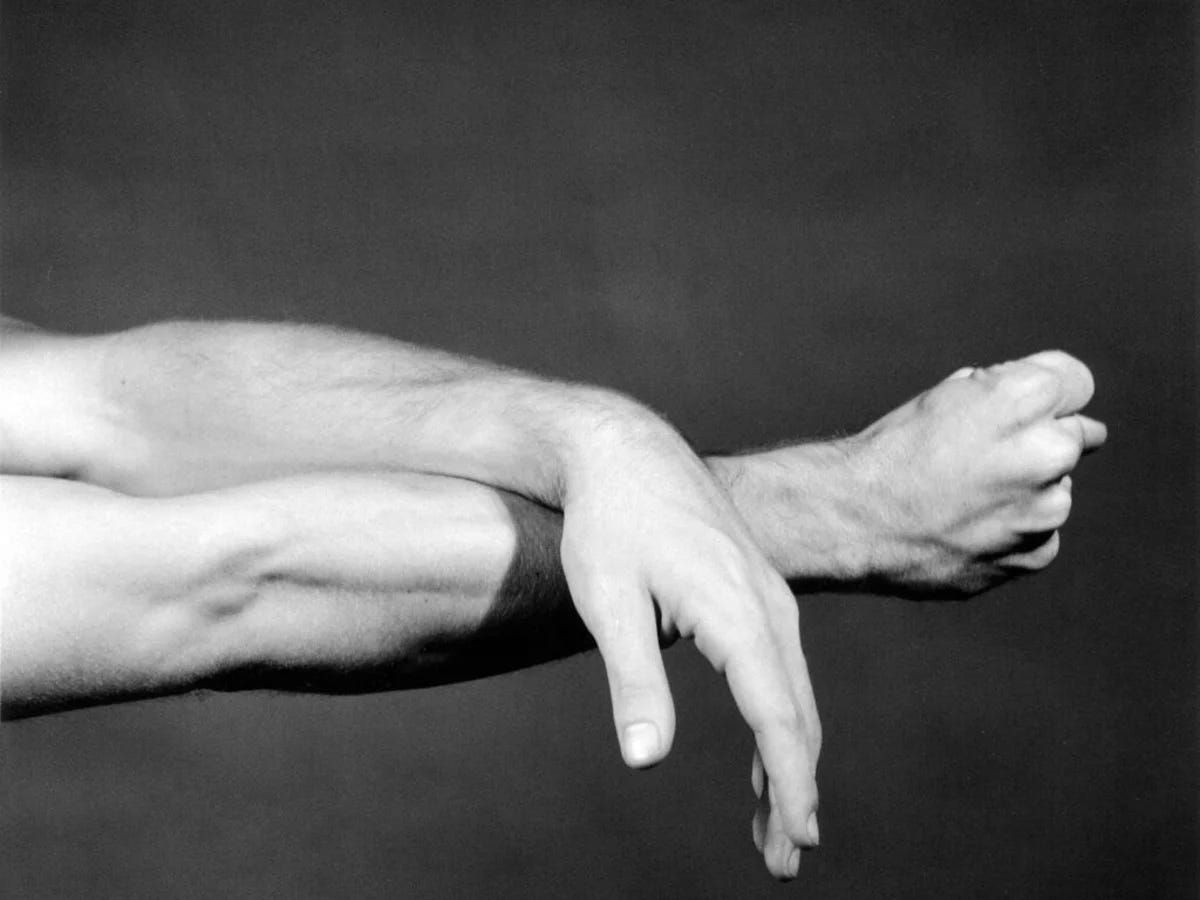
An image by Robert Mapplethorpe.
It turned out the “photos,” which I still have, were actually postcards. David had picked them up at the Oscar Wilde Memorial Bookshop on Christopher Street, the first gay bookstore in America, opened in 1967, named after Oscar Wilde, where postcards and books and periodicals sat in racks and on shelves, and you could walk in off the street and find birthday cards, books, music, and all those things that had your name on them. That is how images moved in 1982, before the internet, before everything was instantly available everywhere. You walked into a bookstore on Christopher Street, and you found three postcards in a rack of dozens, and you carried them home on the 6 train, and you put them in a frame above your kitchen table. Right now, I can look at the boxes under my stairwell and see a huge plastic box full of post-cards. They’re from stores, museums, rest stops, art exhibits, and a lot that people travelling sent me.
I kept thinking about those three photographs above David’s kitchen table. Why are they up on the wall, and all the others are in the box? What they had given me, in the years that followed, was not comfort exactly. It was more like evidence. Evidence that the body, that specific body, had been looked at with complete seriousness, and that the looking itself was a kind of argument. It took me years to find the person who had made that argument most precisely.
By the mid-1980s, besides working at the church, I was spending a lot of my time working in hospitals, doing visits to people I often, actually usually, didn’t know. I was a member of ACT-UP and Queer Nation, and as I was the minister at the church in the East Village, my name often came up when the families of men who were dying of AIDS, often their moms, would call the church and ask for someone to visit because their own priests and ministers were afraid to go or had rejected their sons for some theological reason I failed to understand. I always asked, directly, what they needed from me. Some wanted a blessing, some a simple prayer, some wanted someone to read a Bible passage with them, and some wanted communion for their sons before they died. I wanted to know what to bring along. I had my “kit” in the bookcase. I had a Catholic priest show me how to give last rites, and even had a “Last Rites/Communion emergency kit” the size of a paperback book to take with me. These were not the beautiful young men of the photos.
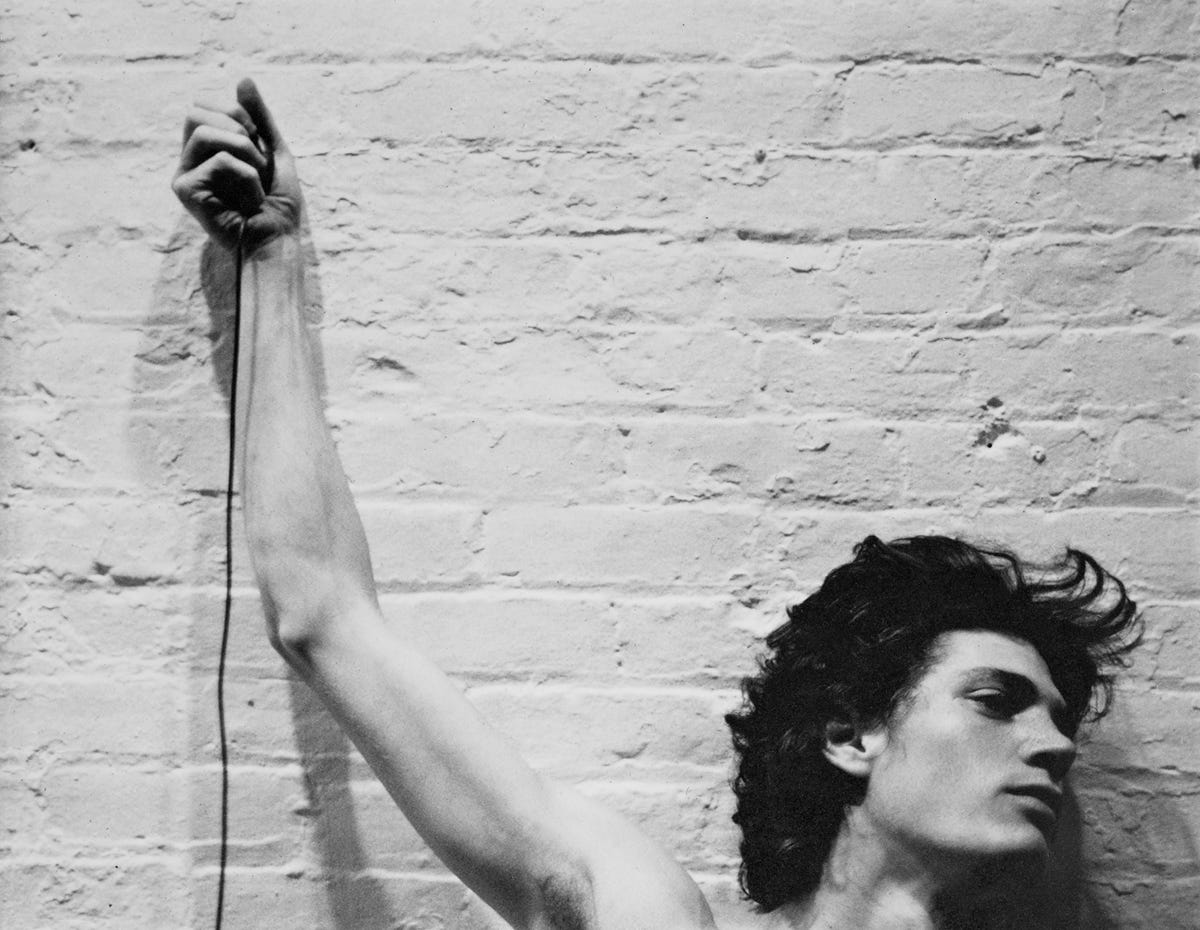
A Self-Portrait by Mapplethorpe
I sat with men in the condition that AIDS produced before the drugs that would eventually make it manageable, when the body failed in specific and terrible ways. I knew, by the middle of that decade, what a body in that condition looked like. I knew it in considerable detail. When the elevator at one of the hospitals I visited came to my floor, the AIDS ward, I would step in, and people would move away, someone would press the button for the next floor and a lot of people would get off.
Dennis Embry had left home at seventeen, the way people leave home at seventeen when home had decided it could not accommodate who he was. He came to New York, the way young people come to New York in that circumstance, because New York was where you could be yourself, or at least where you could try. He was an actor and a playwright. He had worked in off-Broadway shows. But I remember this: Dennis had wallpapered his bathroom with Alcoa Aluminum Foil, it was a sight to see. When you turned on the light, reflections were everywhere. Sometimes when I visited him, he and two other guys would be sitting around his kitchen table discussing their pain meds, trading pills along with stories that I regret are lost now.
I was working in Virginia when Dennis called and asked me to come as soon as I could. I flew home the next morning. I needed a short nap before taking the train into Manhattan. When I got to his room, he was sealed in an orange plastic bag. Tape covered the zipper, just to make sure. The words on the bag said Contaminated Do Not Open. I lost my composure, leaving, yelling at the person at the front desk for letting me walk into that.
Later, Dennis’s parents called. They were coming to New York to see him, and I had to tell them he was gone. Dennis had come from the South, and his being gay had been met with something less than enthusiasm. He had left at seventeen in part because of that, and he seemed, in the years I knew him, to carry that leaving with him. I told his parents that Dennis had been looking forward to seeing them. That it meant a great deal to him that they were coming. When I hung up, I sat at my desk for a long time. I knew that what mattered at that moment was their grief. After the call, I sat there, and I cried. I tried not to keep too many important books on my desk because I tended to throw them across the room at the wall. There were a lot of things then that could make me throw a book.
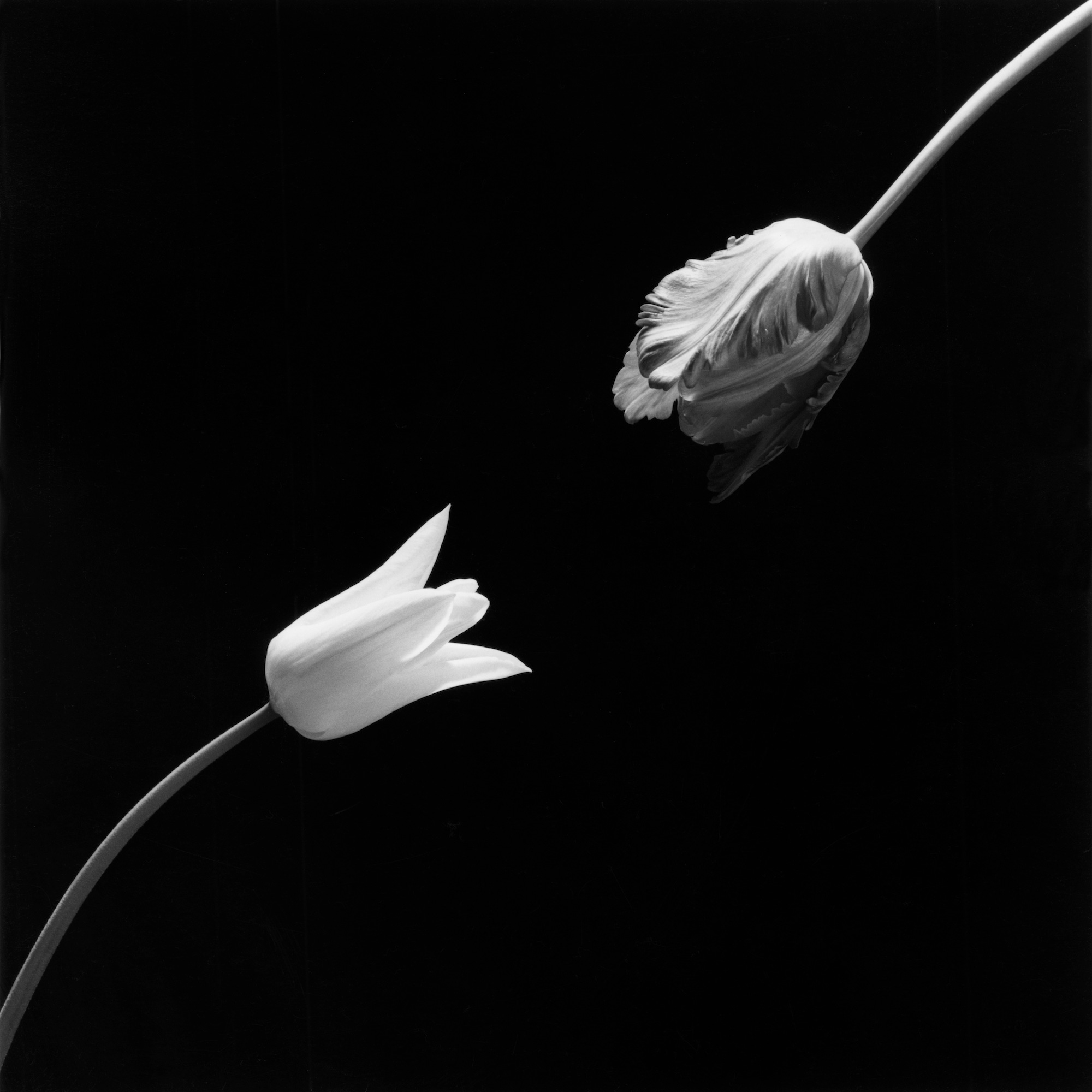
Tulip, by Mapplethorpe
Dennis’s plays are in my bookcase. They have nowhere to go. I wish, deep inside, that I could remember everyone from then as beautiful. Like in those three photos. But I can’t. The photographs above David’s table did not know any of this. They hold still in a different time, when I guess we were all beautiful.
…
Desire
Dave Hickey was an art critic from Texas who spent a significant part of his career in Las Vegas, which he understood as a place where “people were honest about wanting things.” In 1988, he was sitting on a panel, barely paying attention, he admits, when someone in the audience asked what the issue of the 1990s would be. He said beauty.
The room did not know what to do with that answer. The word had been evacuated from serious art criticism and thought for the better part of a century, replaced first by the formal concerns of modernism and then by the theoretical concerns of postmodernism, neither of which had much use for the idea that a work of art might be valuable because it was beautiful, because it reached out and did something to the viewer, because it reorganized desire.
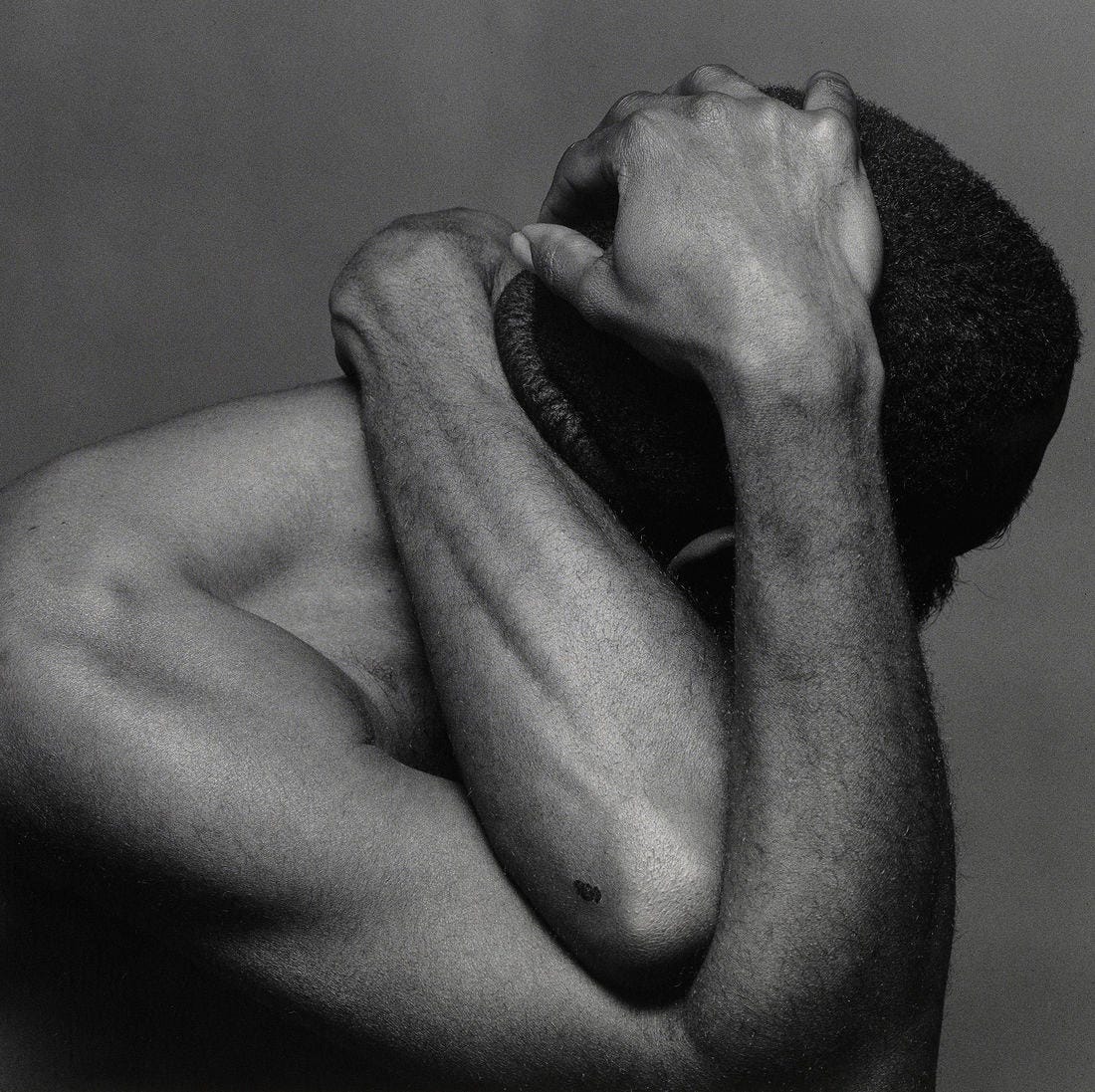
Portrait by Mapplethorpe
Hickey’s argument, made across a series of essays collected in “The Invisible Dragon,” first published in 1993, is that beauty is not a formal property of objects. It is not something that resides in the thing being looked at, waiting to be discovered by a sufficiently educated eye. Beauty is what happens between the image and the beholder. He said, “It is efficacious, which means it has effects.” It changes people. It reaches across the space between the image and the person standing in front of it and does something that cannot be entirely anticipated or controlled. And this, Hickey argues, is precisely why institutions, museums, universities, government arts bodies, the whole apparatus of what he calls the therapeutic institution, are suspicious of beauty. An institution that controls meaning cannot control beauty. Beauty bypasses the institution and works directly on the person standing in the room.
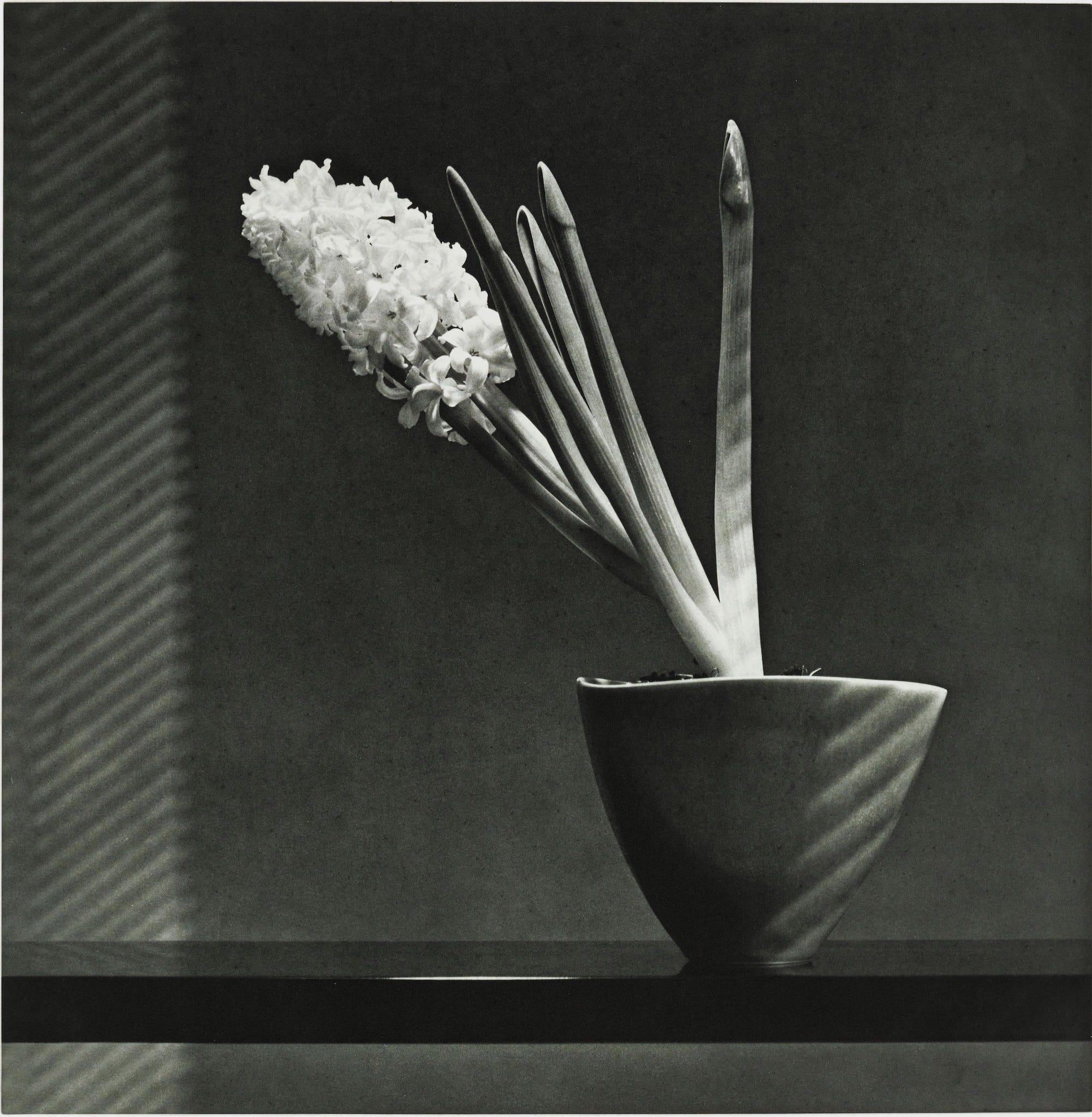
There was something specific about the way gay men in that neighborhood, in that period, attended to beauty. You saw it in how they dressed, in the care taken with a window box on a fire escape above Avenue A, in the way a bar on Christopher Street would be lit. Mapplethorpe understood this from the inside. He photographed calla lilies in vases and men in leather harnesses with the same compositional discipline, the same quality of light, the same refusal to rank one subject above another. I have several of his books, male figures and plants both, and what holds across all of them is the attention. The subject changes. The attention does not. Hickey’s argument explains why this was not incidental. A community that had been told its existence was shameful, its body wrong, its desire illegitimate, developed a particular relationship to beauty. Not as compensation. Because beauty is what you bring to bear on something you believe is worth looking at. The argument was in the looking itself. The East Village in 1982 was full of people making that argument, in the way they moved, in what they hung on their walls, the way they wallpapered their bathrooms in aluminum foil, in what they carried home on the train.
The essay in which Hickey makes this argument most precisely is called “Nothing Like the Son,” and it concerns Robert Mapplethorpe, specifically the X Portfolio, a series of photographs Mapplethorpe made in 1978 documenting the gay male S&M subculture of New York City. In 1990, a museum director in Cincinnati was prosecuted for displaying these photographs. The trial became a focal point for the culture wars of that period, the argument about whether public money should fund art that certain people found obscene. Well, not really the art, but that ability to have an effect on the viewer through the object.
About Hickey’s title, and why I mention it here: Hickey’s pun on Shakespeare’s line “nothing like the sun” is exact and worth sitting with. By replacing sun with son, the title moves the argument from idealized beauty to the specific problem that Dennis and Dave and Robert Mapplethorpe all lived inside: a culture that understood homosexuality as a failure of generational continuance, a son who does not reproduce the father, who does not carry the line forward in the way the father requires. The sun in Shakespeare’s sonnet is what ideal beauty is always being compared to, and always failing to match. The son in Hickey’s title is the person who fails, or refuses, to mirror the man who shaped him. That refusal is what the photographs are about. That refusal is what got the museum directors prosecuted for showing Mapplethorpe’s works.
Hickey’s position on the obscenity trial is counterintuitive and exact. He argues that the politicians and religious groups who wanted the photographs banned understood them better than the curators and academics who defended them. The defenders abstracted the photographs, praising the formal achievement of Mapplethorpe’s technique, the way the stark black and white prints owed something to Caravaggio’s chiaroscuro, the high contrast light that Caravaggio used in paintings like The Calling of Saint Matthew, where a shaft of light falls across a group of figures in a dark room and one of them looks up, caught in the light, caught in the moment of being called. Hickey says the defenders abstracted the photographs further, into principles of free expression, the social value of art in general, and the importance of protecting difficult speech. What they did not do was talk about what the photographs actually showed, or why Mapplethorpe had made them so damned beautiful.
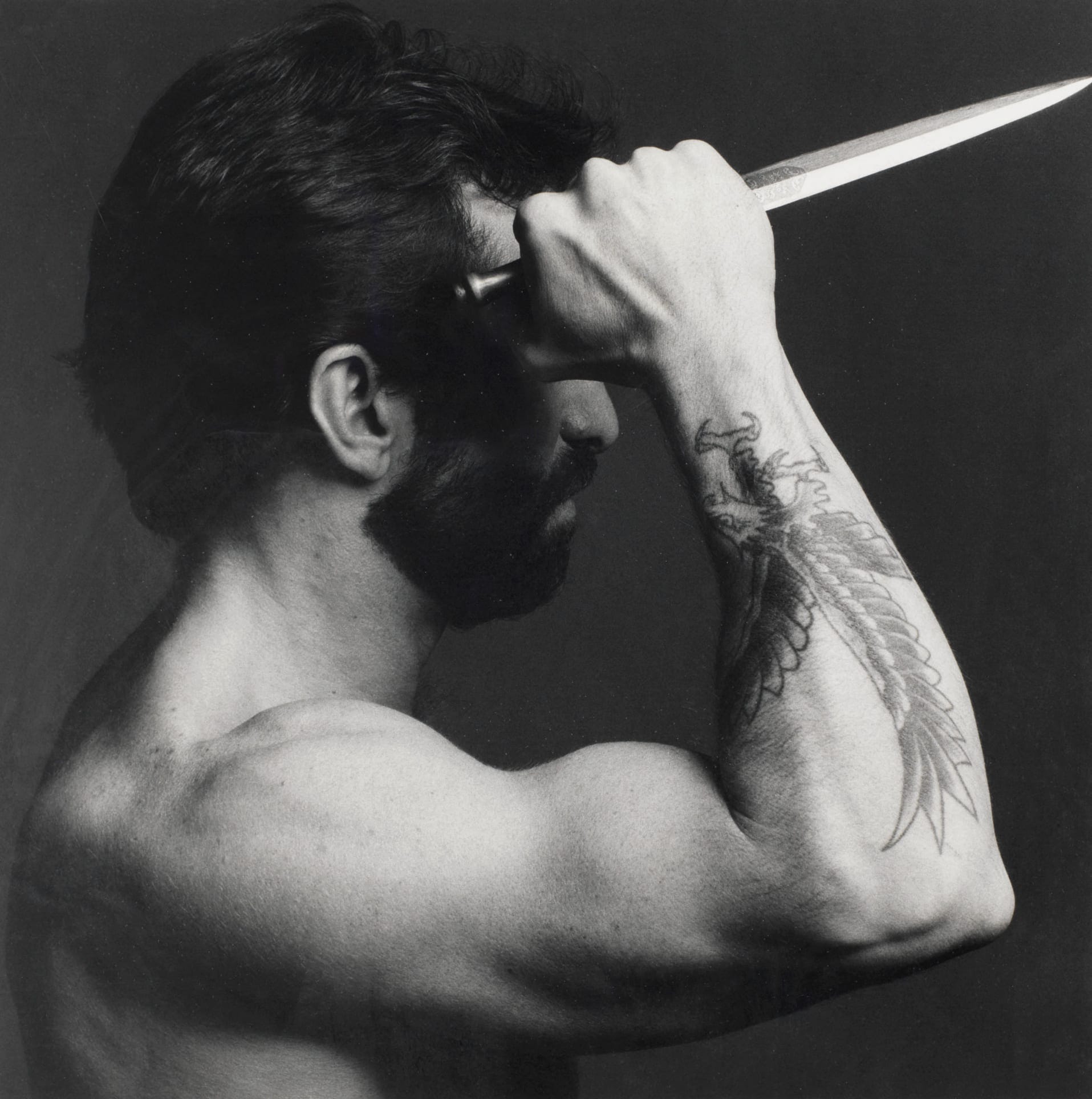
Portrait by Mapplethorpe
But the censors talked about what the photographs showed. They understood that Mapplethorpe had applied the full discipline of fine art photography, the discipline he had developed shooting flowers in vases and portraits of celebrities, to acts that the culture had decided were not entitled to that quality of attention. They understood that the beauty of the photographs was an argument. The photographs were saying: this is real, these are people, this is what some people do and who some people are, and it is worth looking at with complete seriousness. The censors found that argument dangerous. They were not wrong about what kind of argument it was. They were wrong about what to do about it.
Portrait by Mapplethorpe
Catherine Opie understood this, and her work extends Hickey’s argument in ways that make clear it is not an argument about one photographer or one subculture or one decade. Opie’s self-portraits of the early 1990s, “Self-Portrait/Cutting” (1993) and “Self-Portrait/Pervert” (1994), apply the same formal discipline, the same studio light, the same quality of complete attention, to her own body. The result is the same kind of argument Mapplethorpe was making: this is real, this is a person, and it is worth looking at seriously. I have owned a couple of her images for years. What drew me first was the directness, the same quality I had recognized above David’s kitchen table. Over time, as Opie moved toward landscape, toward the American West and its highways and its flat light, what stayed constant was the question underneath the work: who belongs here, who is entitled to be seen, who is trespassing. The New Topographics tradition she works within, photographers like Robert Adams and Lewis Baltz who photographed the ordinary, damaged, unbeautiful American landscape with complete formal seriousness, asked the same question about place that Opie asks about the body. Hickey’s idea of the image making itself available, reaching across the space between the photograph and the person standing in front of it, holds for all of it. Beauty, aimed at the wrong subject, is understood as provocation, whether or not provocation was intended.
But Hickey’s larger point is about the relationship between beauty and transgression. Transgression defines itself against a norm and therefore depends on the norm for its energy. A work of art that matters because it breaks a rule needs the rule to keep mattering. Mapplethorpe was not interested in rules. He was interested in beauty. He said, in an interview late in his life, that he did not see much difference between a photograph of a fist and a photograph of carnations in a bowl. This is not provocation. It is an aesthetic position, held consistently across an entire body of work. The same light. The same compositional precision. The same quality of attention, regardless of subject.
This is also what Hickey means when he talks about the image presenting itself, making itself available to the beholder. A Mapplethorpe photograph does not explain itself or justify itself or ask for your understanding. It simply presents the subject with complete formal seriousness and waits. The beholder is changed by the encounter, or is not, but the photograph does not modulate itself according to the beholder’s comfort. It holds still. It persists. It offers itself. And the offering is the argument. Those three photos on the wall over the kitchen table, it turns out, were not a provocation. They were just about beauty. And those three images above the table were the best argument against the coming dark.
…
CODA
A Note on the Photographers who made the postcards:
For 40 years, I wondered who made these photos. A few times I searched, but never found any leads. This time, I guess with the advent of better internet searches, I have located these two photographers who have lived on my wall for 40 years or so:
Hans van Manen was born in 1932 in Nieuwer-Amstel, a suburb of Amsterdam. He became one of the most significant choreographers in the history of European ballet, creating around 150 works for the Nederlands Dans Theater and the Dutch National Ballet. He was among the founding members of the Nederlands Dans Theater, which began as what was described at the time as a rebel group, a company willing to break with the formal conventions of classical ballet. He served as its artistic director from 1961 to 1970. He was active in the Dutch gay rights movement. He married his longtime partner Henk van Dijk in 1999, when the Netherlands became the first country in the world to legalize same-sex marriage. He died in Amsterdam in December 2025, at the age of 93.
The photography was a secondary career, practiced quietly alongside the choreography, and it began because of Mapplethorpe. Van Manen came into contact with Mapplethorpe personally, and this contact inspired him to pick up a camera himself, as a way, he said, of finding peace in the studio and the darkroom, away from the intensity of working with large groups of dancers. He worked always in square 6x6 format. He photographed almost exclusively dancers. His book “Portrait” was published in 1986. Of his approach to the nude, which was a central subject of his photographic work, van Manen said: “I love the nude. Wearing clothing means filling the gaps in a story. I want to present something else: information, an impression, not a personal account. I make portraits of people and parts of their bodies that are as beautiful, objective, and unsentimental as possible, but not insensitive.”
Erwin Olaf Springveld was born on 2 July 1959 in Hilversum, Netherlands, and worked professionally under the name Erwin Olaf. He enrolled at the Utrecht School for Journalism, though he eventually went a different direction entirely, drawn toward photography after a teacher noticed he was unhappy in a writing-focused environment and invited him to a photography class.
In the 1980s, Olaf photographed Amsterdam’s party scene and documented the gay liberation movement taking place there. So in 1985, the year you’re asking about, he would have been 25 or 26, working in Amsterdam, embedded in that scene. He started out documenting pre-AIDS gay liberation in Amsterdam’s nightlife, and this activistic approach to equality would remain a through-line for his entire forty-year career.
He quickly began to move away from traditional documentary photography and embraced staged photography, asking punks and members of the queer community to pose for him in his studio. This shift, from witness to director, is what defined him. Starting in black and white series like “Chessmen” and “Blacks,” he increasingly sought and defined his own subjects.
It was “Chessmen” that made him internationally famous, winning him the Young European Photographer award in 1988. So by 1985 he was still building toward that. The work was there. The recognition came a few years later.
Like Gregory Crewdson, Olaf staged his large-scale images in a cinematic fashion, with orchestrated sets and dramatic lighting, and his practice often explored issues of historical and contemporary importance. Time magazine described his work as straddling the worlds of commercial, art and fashion photography at once.
He died on 20 September 2023, at the age of 64, after receiving a lung transplant. He had been diagnosed with emphysema in 1996 and had been told not to expect to live past 60. He made it to 64. In 2018, the Rijksmuseum acquired 500 key artworks from his forty-year career for their permanent collection.
Image Credits and Fair Use
Images are reproduced here for purposes of criticism, commentary, and scholarship under principles of fair use (U.S.) and fair dealing (Canada, UK, and Europe). Copyright remains with the respective artists, photographers, estates, or rights holders. If you are a rights holder and would like an image credited differently or removed, please contact me and it will be addressed promptly.
You can find excellent images by Mapplethorpe on his foundation’s page, and at MoMA.