
The Only Ground Available
On finding things in the dark.

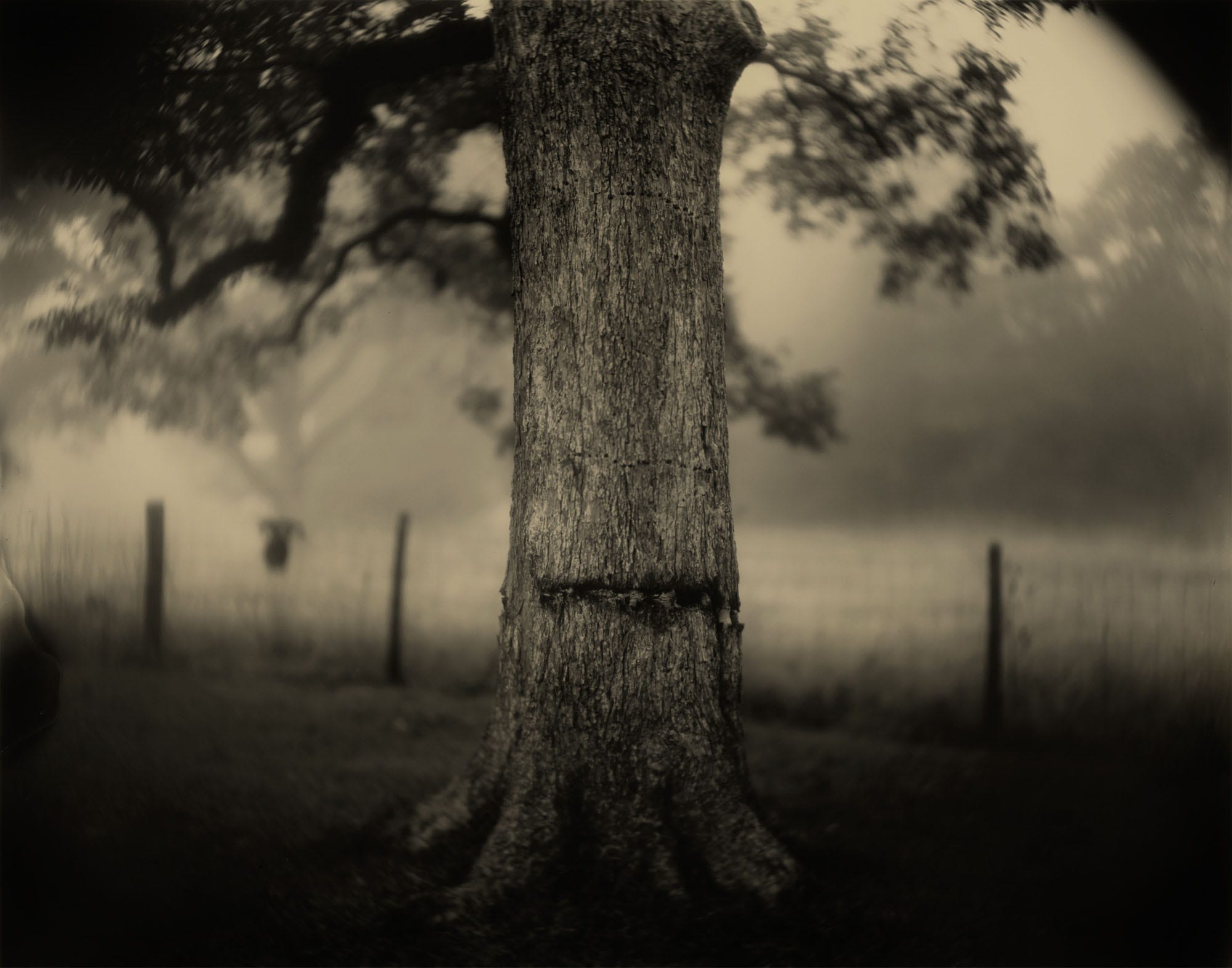
The Scarred Tree by Sally Mann
I had only a little time before Newton needed the car for the day. It was Wednesday morning, 5 a.m. I took a few minutes to clean the sensors on both cameras, wiped down the bodies, cleaned the mounts, and finally the lenses. This is the kind of thing you do when you’re not sure what to do next. You clean equipment. You make the instruments ready for a decision you have not yet made.
I had been taking high-resolution images for 10+ years, 61 megapixels, using a Sony A7R5. These images hold more information than the human eye can process in a single moment. I sometimes, too often really, also use focus stacking, which means taking multiple exposures at slightly different focus distances and merging them, a process that produces an image of impossible sharpness throughout the entire frame, foreground to background, corner to corner, every surface rendered as precise as possible. The technique is exacting; dew drops can be counted on the blades of grass. The work I had been doing in Japan for three years was like this, highly focused, long-exposure, zero-grain. Everything visible. Nothing lost. The method had become comfortable, which was part of the problem.
Then, I saw the image above by Sally Mann. Deep South, Untitled (Scarred Tree), 1998. A tea-toned gelatin silver print, 40 by 50 inches. Tea toning is a chemical process applied during darkroom printing in which the silver in the print is partially converted by the tannins in tea, shifting the whites toward warm amber and sepia rather than leaving them as stark white. Mann uses this process deliberately. It pulls the highlights back from the edge of blankness. It gives the brightest parts of the image presence, and a weight they would not otherwise have. The result in the Scarred Tree image is a deep, dark, dense surface in which the wound in the bark holds the eye the way a face does, and the surrounding woodland presses in from every side.
I do not use tea toning. My whites were already telling me something about what I had not yet learned to control. Mann, sometimes, mixes in some dust, dirt, and debris from the ground. It connects the images to the southern landscape they are taken in. Once, in an interview, I heard her say: “The skill is knowing when enough is enough.”
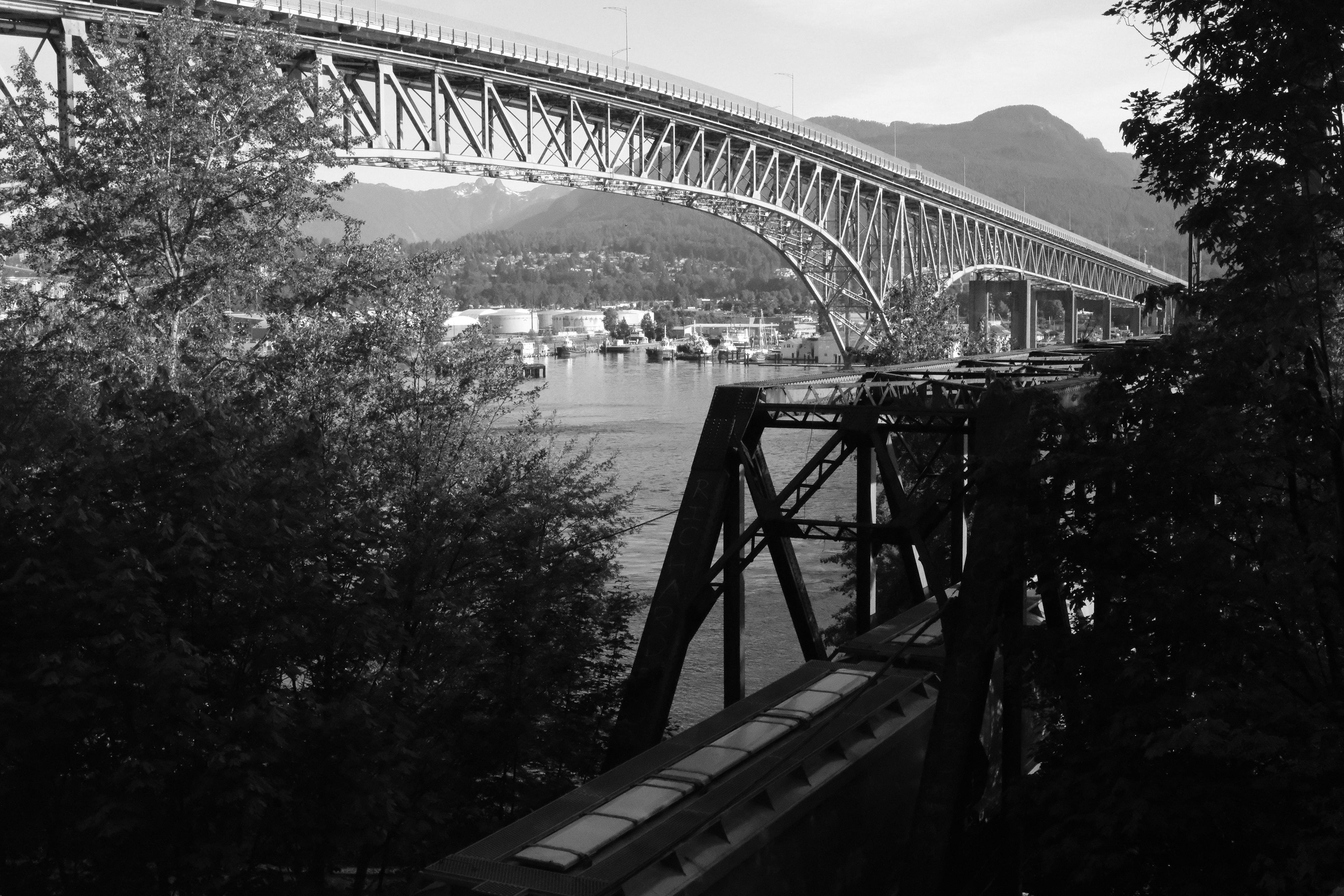
A B&W Image I took near the tree fort
Besides my Sony, that morning I also brought a small camera. A Fuji XT50. The Fuji has an APS-C sensor, roughly half the surface area of the Sony’s. It has less dynamic range, meaning the gap between what it can hold in the bright parts of the image and what it can hold in the dark parts before one, or the other, loses detail is narrower than what I am used to. It also has a different “color science,” the way the sensor and processor interpret and render tone, which affects how colors separate when you convert to black and white. I was not sure what I was doing with it. That was, I think, the point, taking some new risk and, to a point, flying blind.
I went to a small woodland at the edge of an industrial zone in urban Vancouver, where teenagers often build tree forts overlooking two train tracks, one going east-west, a second going north-south. Their forts overlook the Iron Workers Memorial Bridge, which Vancouverites call the Second Narrows. Below in the inlet, tankers load oil brought by pipeline from Alberta. Coal arrives from across the American border. High-pressure gas lines, oil pipelines, and much of the city’s water supply from the Coastal Mountain range all converge and crisscross beneath and around the path. I carried both cameras. I took some of my usual images and some monochrome on the Fuji. I was not yet sure which camera I was trusting.
When I got home, I found a movie on top of the flatbed drawers. Newton had left it there to be returned to the library, not thinking I would want to watch it. But I’ll be going to Scandinavia; my plan right now includes Sweden, Norway, Finland, and Denmark, I had been doing what I always do before traveling somewhere new. Reading some of the literature, at least one well-known novel, and watched local television and films. I don’t do this to find the best restaurant or tourist spots, but to understand why the houses look the way they do, to know enough about the spirit of a place that I don’t miss something important when I am standing in front of it. I had been watching The Bridge, the Swedish-Danish crime series, and what struck me about that landscape was how much it resembled the American Southwest, flat and emptied, a place I have photographed without difficulty. And yet I still feel nervous, or at least unprepared. Not about the flatness. About the method. About what camera I would carry and what I would decide to let go dark. I was thinking of taking this series in black and white. The DVD on top of the drawers turned out to be Finnish, not Norwegian as I first assumed. It was not what I expected at all.
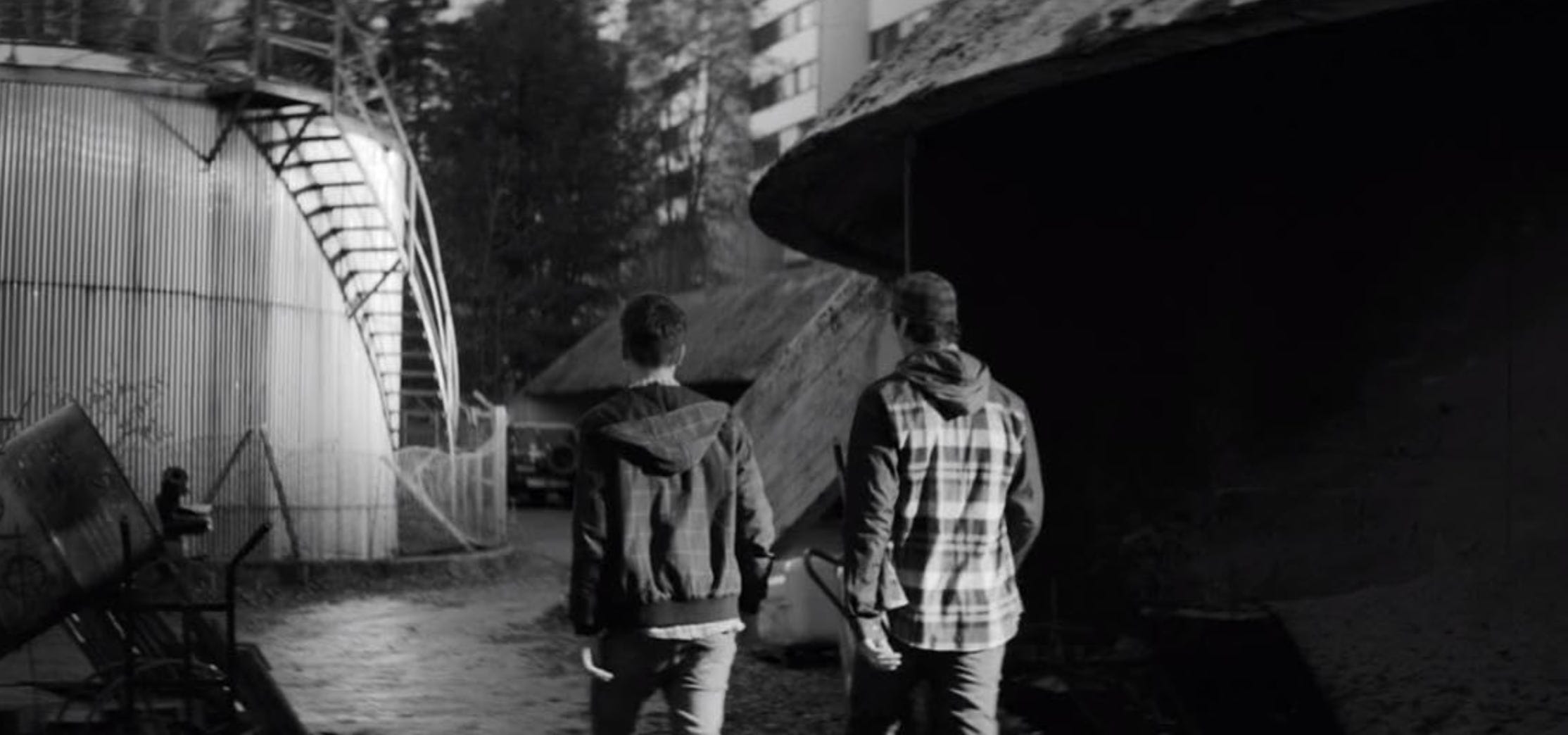
After an opening dream sequence of darkness, water and disaster, we see the a strang eview of a city. Concrete everywhere. Little room to breathe.
Pirjo Honkasalo’s Concrete Night, Finnish title Betoniyö, released in 2013, is based on Pirkko Saisio’s 1981 novel of the same name. Saisio co-wrote the screenplay with Honkasalo, her long-term life partner. The story follows fourteen-year-old Simo through a single night in Helsinki as he accompanies his older brother Ilkka, who is to report to prison the next morning for a minor drug offense. The film uses black and white cinematography and a muted soundscape to build a claustrophobic sense of dread. The setting reflects Simo’s anxiety and confusion, not by illustrating his psychology but by being part of its cause, pressing on him from every surface.
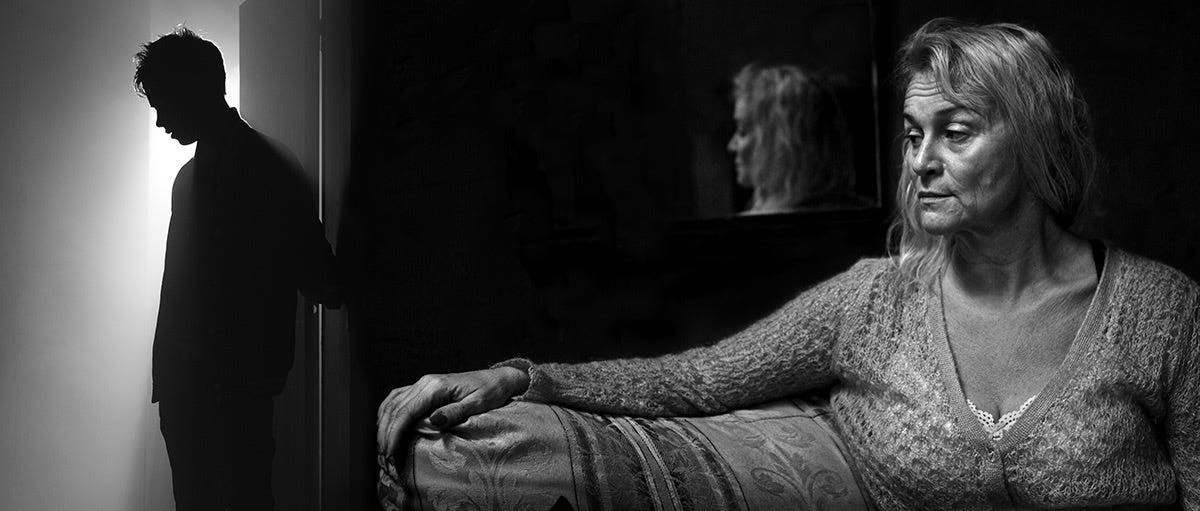
Honkasalo began her career as a cinematographer, graduating from the University of Art and Design in Helsinki. From interviews collected on several film websites, she has spoken about her relationship to narrative, describing the story of a film as essentially structural, a frame that “holds the images rather than the point of them.” The images are the point. The story keeps them from floating free. She has also said, and I am quoting her here because the phrasing is hers and I do not want to dilute it, that “pictures can reach the unspoken part of a human being.”
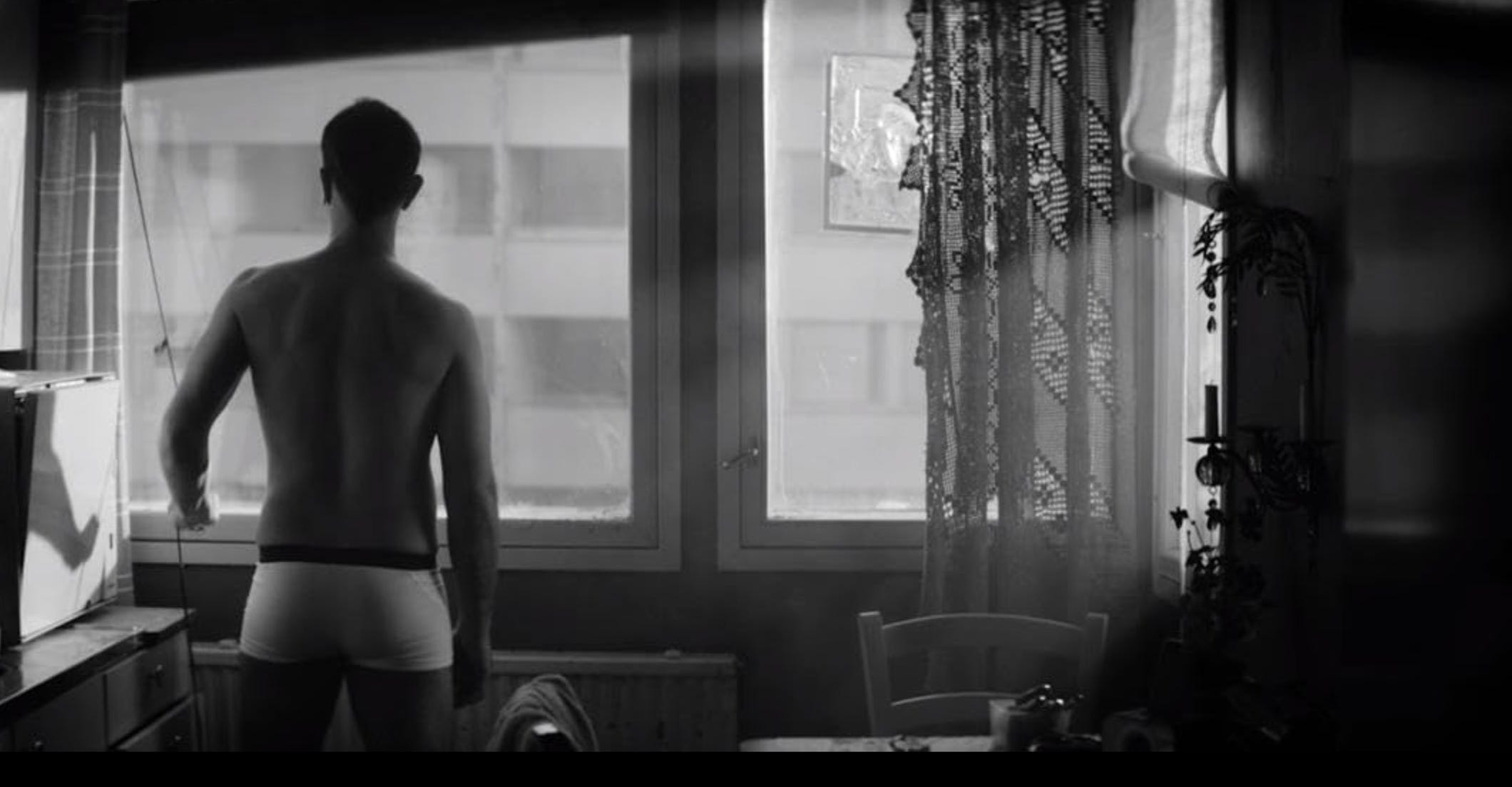
A room full of windows that still remains dark, claustrophobic, and hopeless.
The cinematography here is by Peter Flinckenberg, who won the American Society of Cinematographers Spotlight Award for his work on the film. Reading through critical responses to Concrete Night, I kept finding versions of the same observation: that what Flinckenberg does with Helsinki’s oil tanks, bridges, cranes, and crumbling factories makes them hard to fully believe in, even as you are looking directly at them. In psychology, we have a word for this condition. Uncanny. Freud’s unheimlich: the familiar thing that has become strange, the known place that no longer behaves as known. The structures are real, concrete, yet the film makes them feel like evidence of something else. Nothing is quite right.
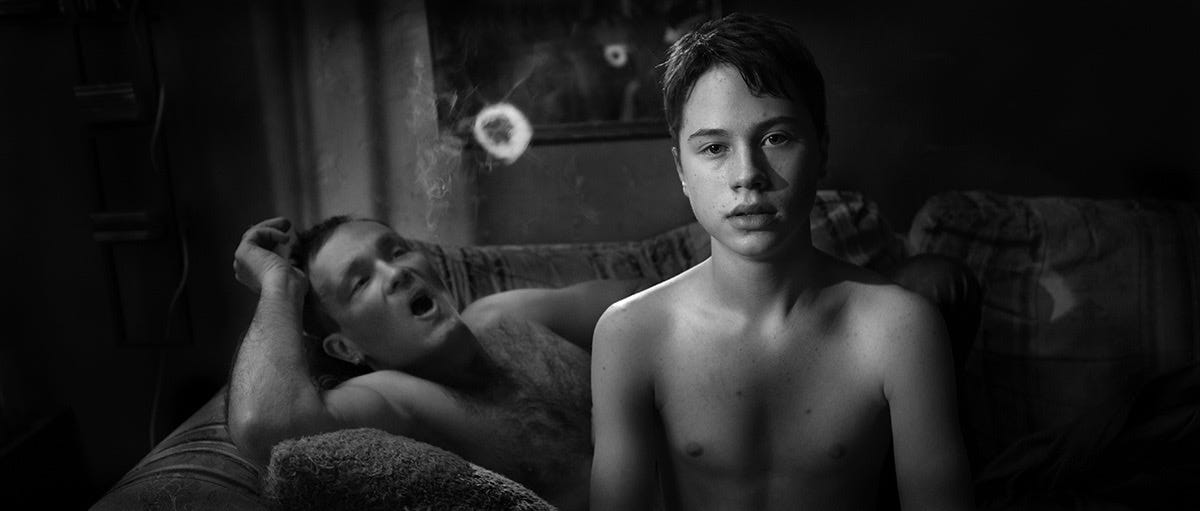
What Flinckenberg does technically is worth naming precisely, because it is what I was trying to understand with my own camera earlier that same morning. The film was shot on an Arri Alexa Studio, a digital cinema camera made by the German company Arnold and Richter, used for high-end feature film production. Almost all digital cameras, including the Alexa, record in color by default. To arrive at the black and white you see in Concrete Night, Flinckenberg shot in color and then converted the footage in post-production. This matters because it means he had precise control over how each color in the original image translated to a shade of grey. A red object and a green object may appear identical in tone to the naked eye, but in conversion, a colorist can push the red toward near-black and the green toward near-white, or reverse the relationship entirely. The Arri Alexa is known for its wide dynamic range, meaning it can hold detail simultaneously in the very bright and very dark parts of an image. The colorist then takes that wide range and compresses it into hard contrast. The shadows go very deep. The highlights go very bright. Here there is not much comfortable grey in between. This is a world “without middle ground,” and the technical process is what produces that condition. The decisions are made at the point of conversion, what will be seen and what will go dark. I realized, watching the film and then looking at my own photographs from that morning, that I had been relying too much on the accidents of available light. I had not yet decided what to let go dark.
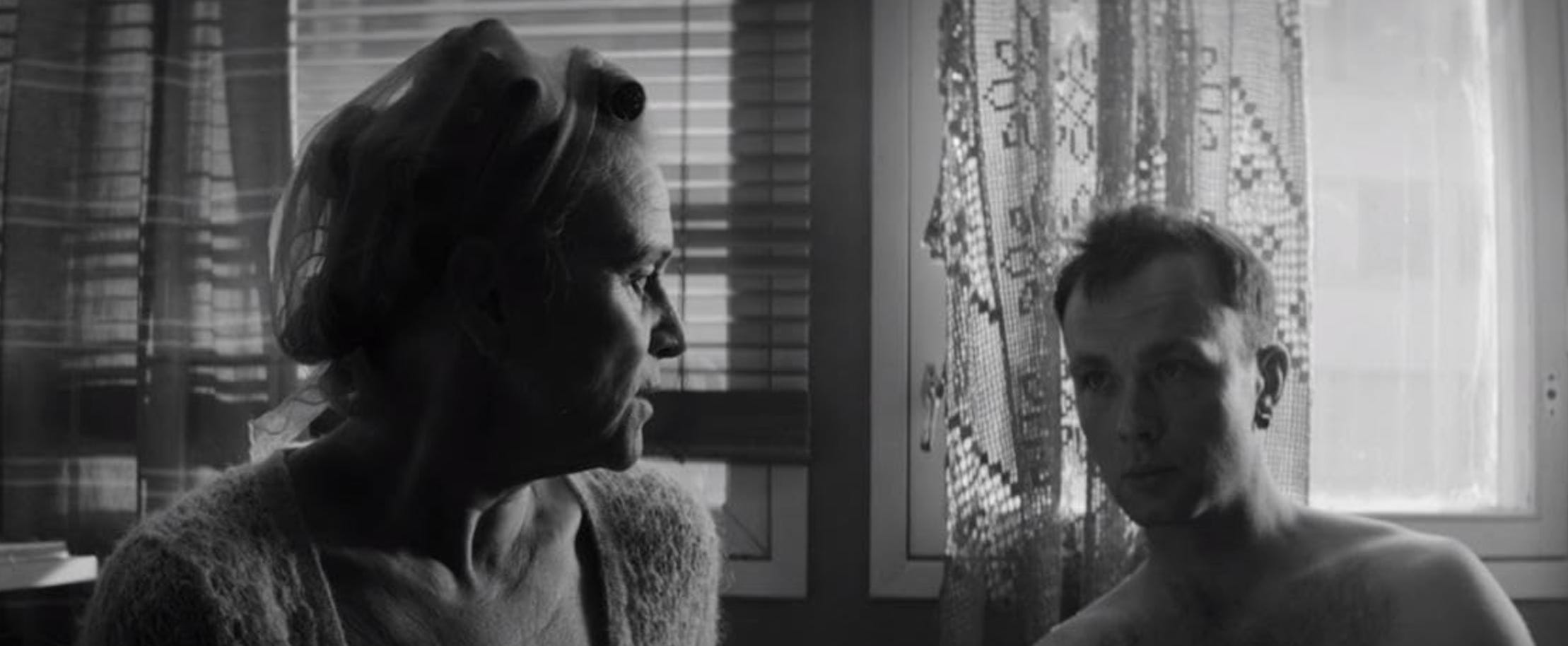
Until I saw this film, I would never have been happy with this image.
Recently, in two other essays, I have been writing about Caravaggio and chiaroscuro, and you cannot watch Concrete Night without thinking about that tradition. Chiaroscuro, the Italian term for the contrast between concentrated light and deep shadow that Caravaggio developed in paintings like The Calling of Saint Matthew, where figures emerge from near-total darkness into a single strong lateral light, is not a technique for making things look atmospheric. It is a technique for making things look true. The light falls on what matters. On truth. In these images everything else goes dark, not because darkness is interesting, but because it is accurate. Flinckenberg works in this tradition. The faces in Concrete Night emerge from shadow the way Caravaggio’s figures do, not glamorously, but with clarity. The clarity of something being revealed under pressure.
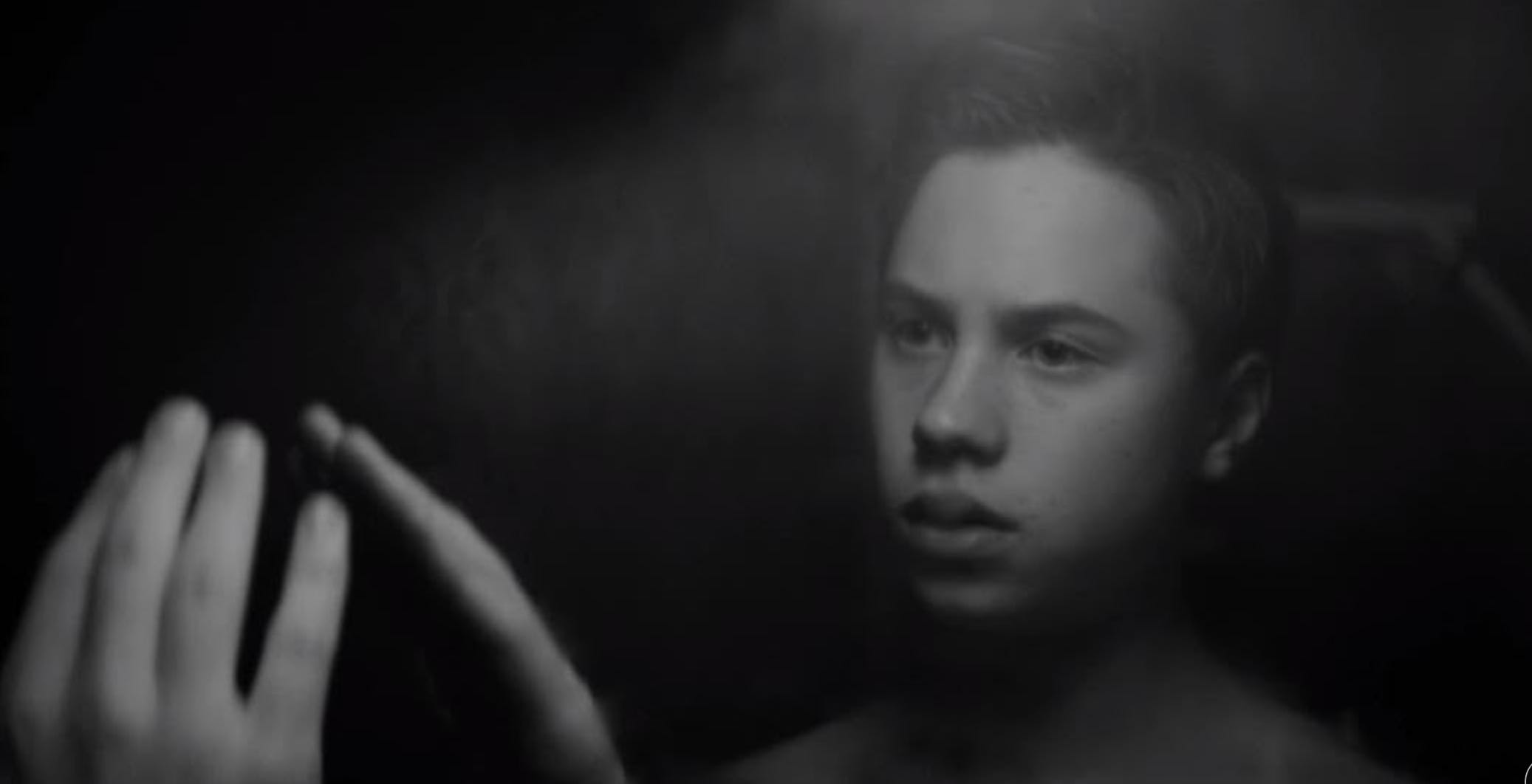
This is worth saying because the temptation, looking at high-contrast black and white images of industrial landscapes and damaged adolescence, is to read them as “noir.” Noir uses darkness differently. In a noir film, in a noir photograph, in the work of someone like Brassaï shooting Paris at night in the 1930s, the shadows are seductive. They make danger look attractive. Those shadows give vice a glamour it would not otherwise have. The rain-slicked street, the figure half-consumed by shadow, the light from a single window: these are beautiful in a way that invites you toward them. Concrete Night is not doing this. The darkness in Honkasalo’s film is not seductive. It does not make the housing block or the rail yard look interesting in the noir sense. It makes them look like what they are. I thought the same is true of my photographs from that morning. The pipeline and the transformer on the pole and the chain-link fence are not noir subjects. They are plain subjects, made plainer by the removal of color. The chiaroscuro tradition and the noir tradition both use hard contrast, but they are after entirely different things, and confusing them is a significant misreading of what this kind of image is trying to do.
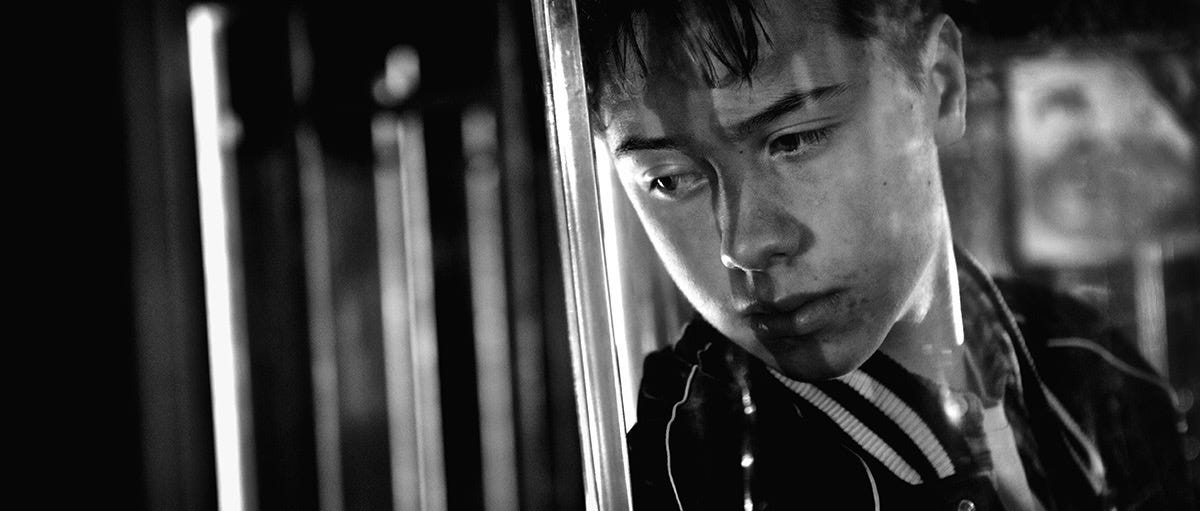
The feeling of being surrounded, pressed in, is the central emotional condition of both Concrete Night and of the place I photographed that morning. In Honkasalo’s film, the concrete architecture of a Helsinki housing block means that from any window there is another wall visible, another building, another surface without horizon. Concrete towers. Industrial sites. Apartment blocks. Rail yards. Underpasses. Vacant lots. In environmental psychology, there is a term for the demands a setting makes on a person, the claims it forces on behavior and identity. Presses. What the film shows, consistently, is the environment pressing on Simo from every direction.
Reading through critical responses to the film, I find the language of psychological landscape used repeatedly, the city as an externalization of Simo’s interior mental state. As a behaviorist, I would put it the other way around. The city does not reflect Simo’s psychology; it produces it. Helsinki is not a manifestation of anything. It is a set of facts. The pressure is real before Simo feels it.
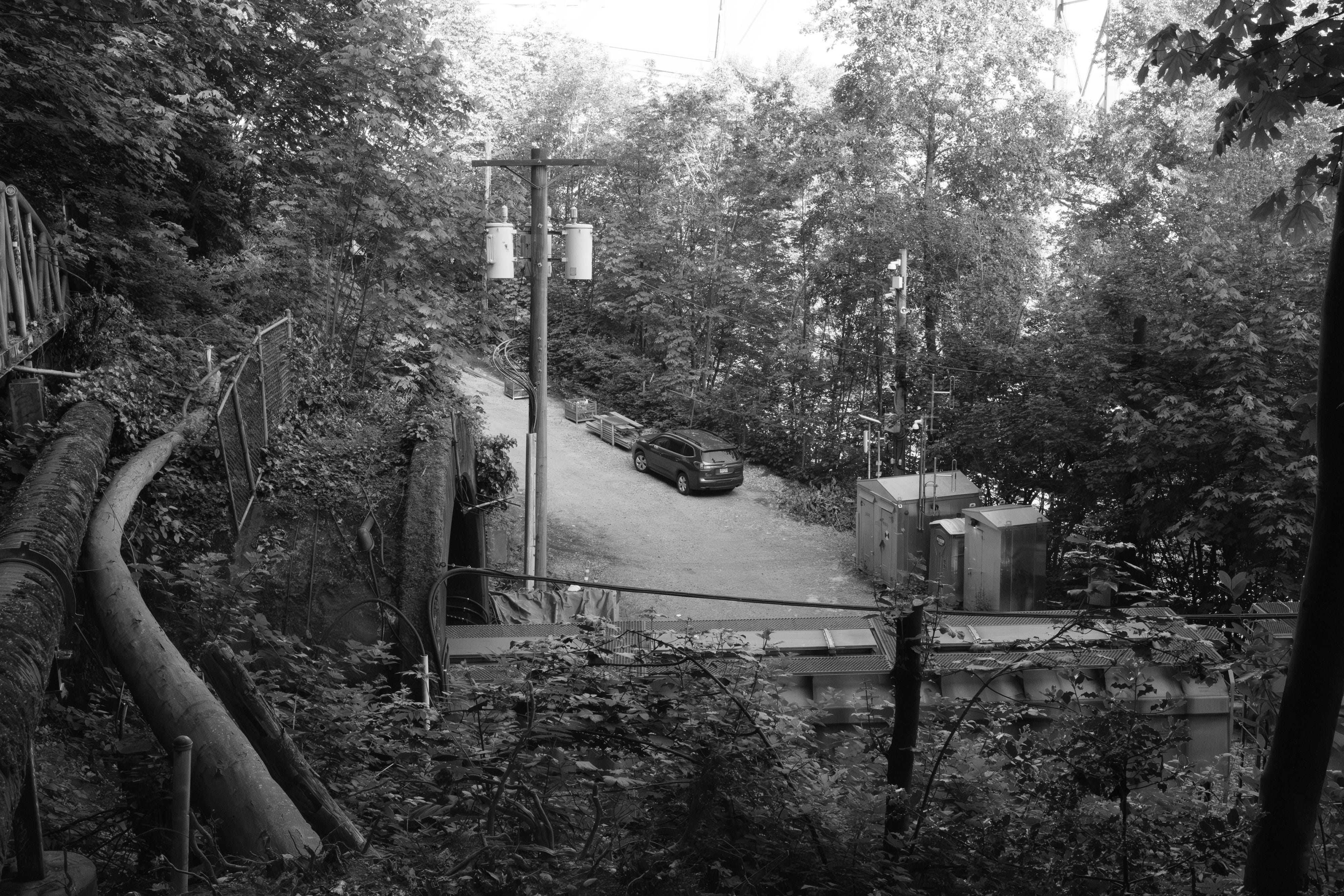
An image from above the train, passing under me at this moment. Another train passes in the other direction; they crisscross, making screeches that sound like attacking birds. In the distance, halfway across the bay, I can still hear the engine rumbling and making a droning sound.
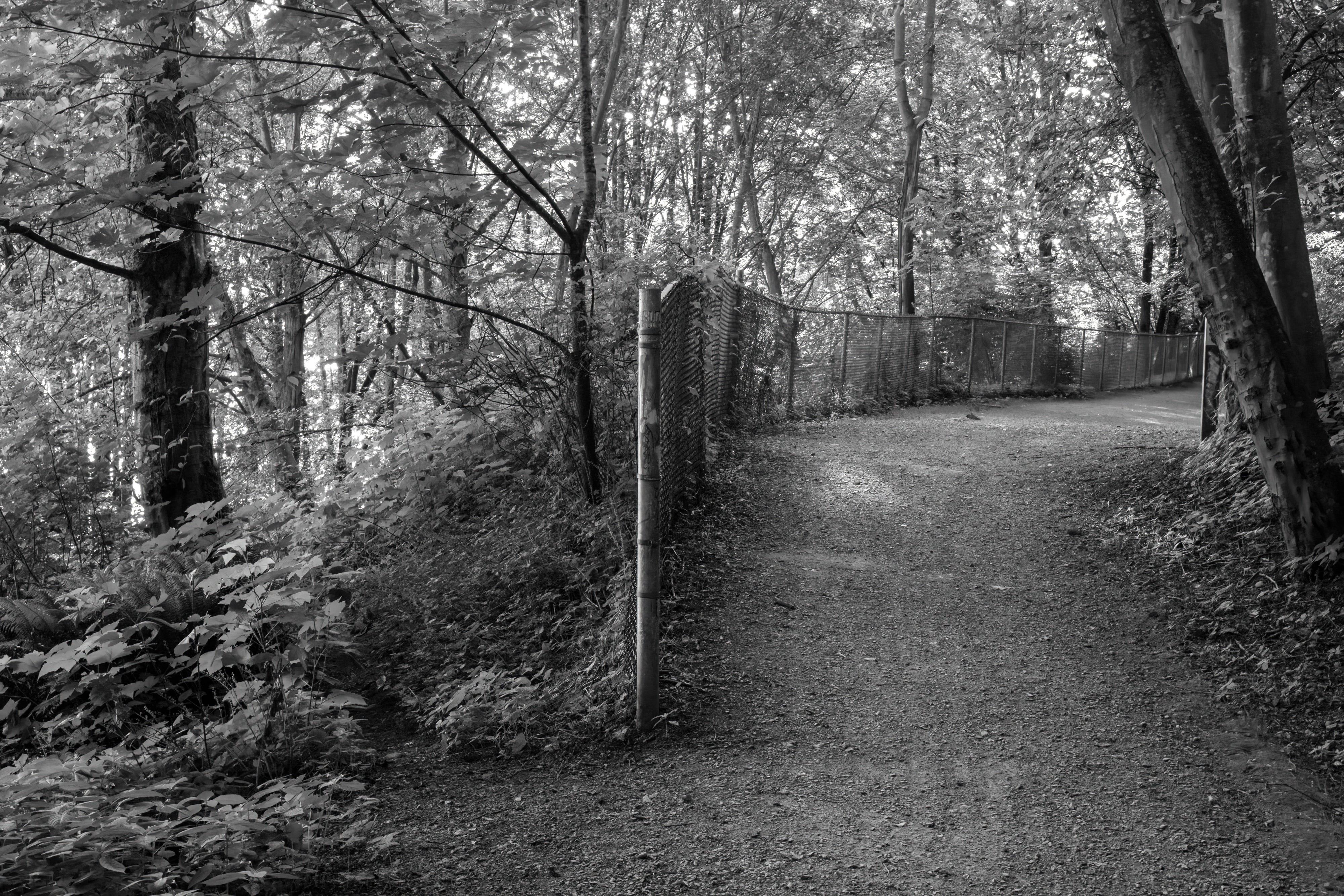
In my Vancouver photographs, the compression works differently but is just as complete. There is a pedestrian path, but it runs between a chain-link fence and a densely wooded slope, which sits above a railroad track, which sits beneath a highway bridge, which itself crosses above pipelines large enough to see from the path. The path is not a place of openness. It is a corridor. The gravel, the fence posts, the overhanging trees, the electric transformers on poles, the parked SUV marking where someone comes to inspect the infrastructure: these things do not leave room. The fourth photograph in particular makes the layering explicit. There is the foreground of fallen logs, then the chain link, then the deciduous canopy, then the bridge span overhead, then sky. Four distinct planes of compression in a single frame.
Flinckenberg builds the same structure inside individual shots. Light floods down in sharp rays. Faces are reflected in dirty water and slivers of mirrors. Watching the film, what I kept noticing was how often it was genuinely difficult to tell what I was seeing. Whether a surface was a reflection or a window. Whether I was looking through something, or at it. Whether the image had been filtered or whether that was just the light. Flinckenberg does not clarify. He lets the ambiguity sit. That is its own kind of pressure, and it is not an effect you can produce by accident. It requires the same kind of decision I was failing to make with the Fuji that morning: deciding, before you press the shutter, what the image is actually of.
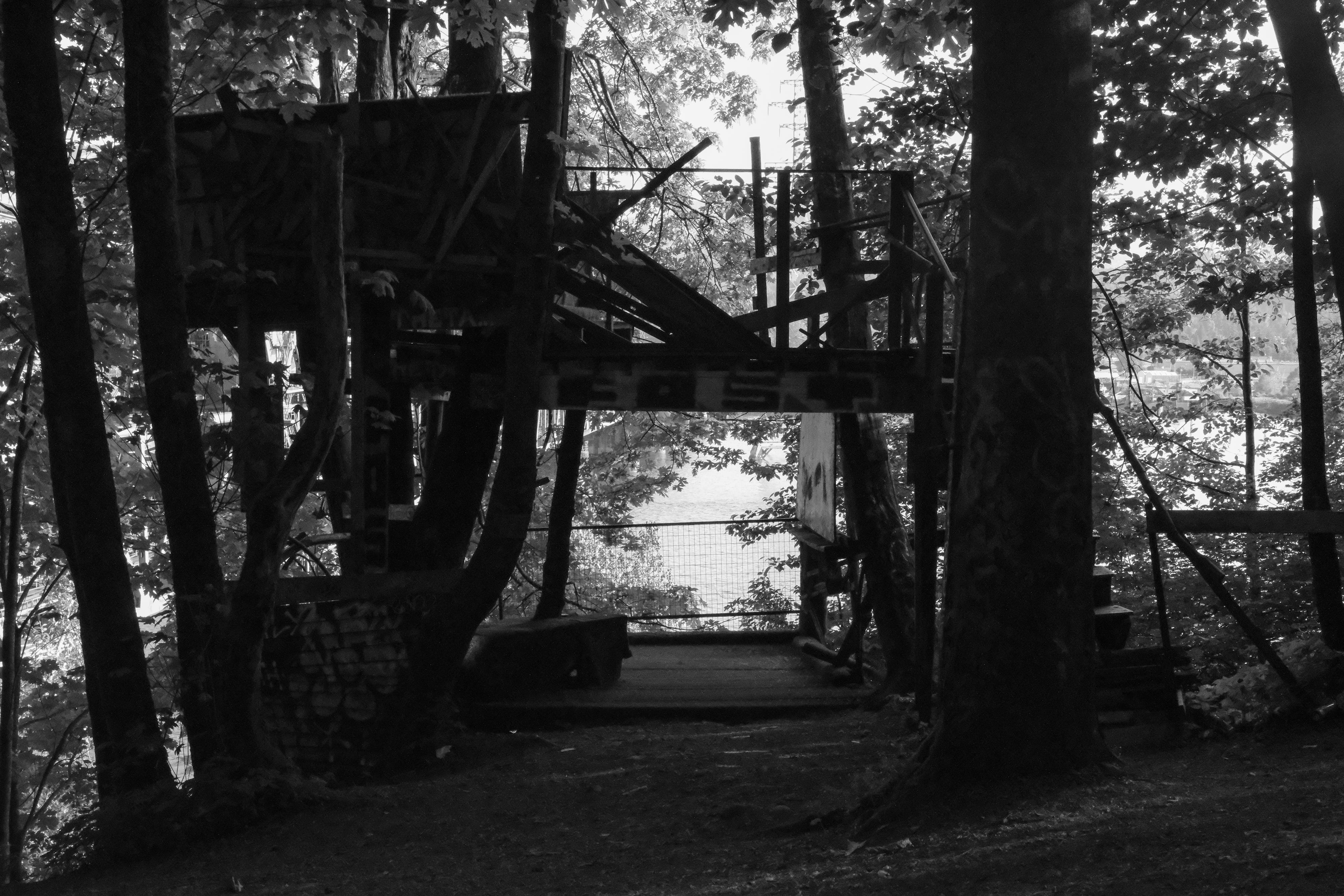
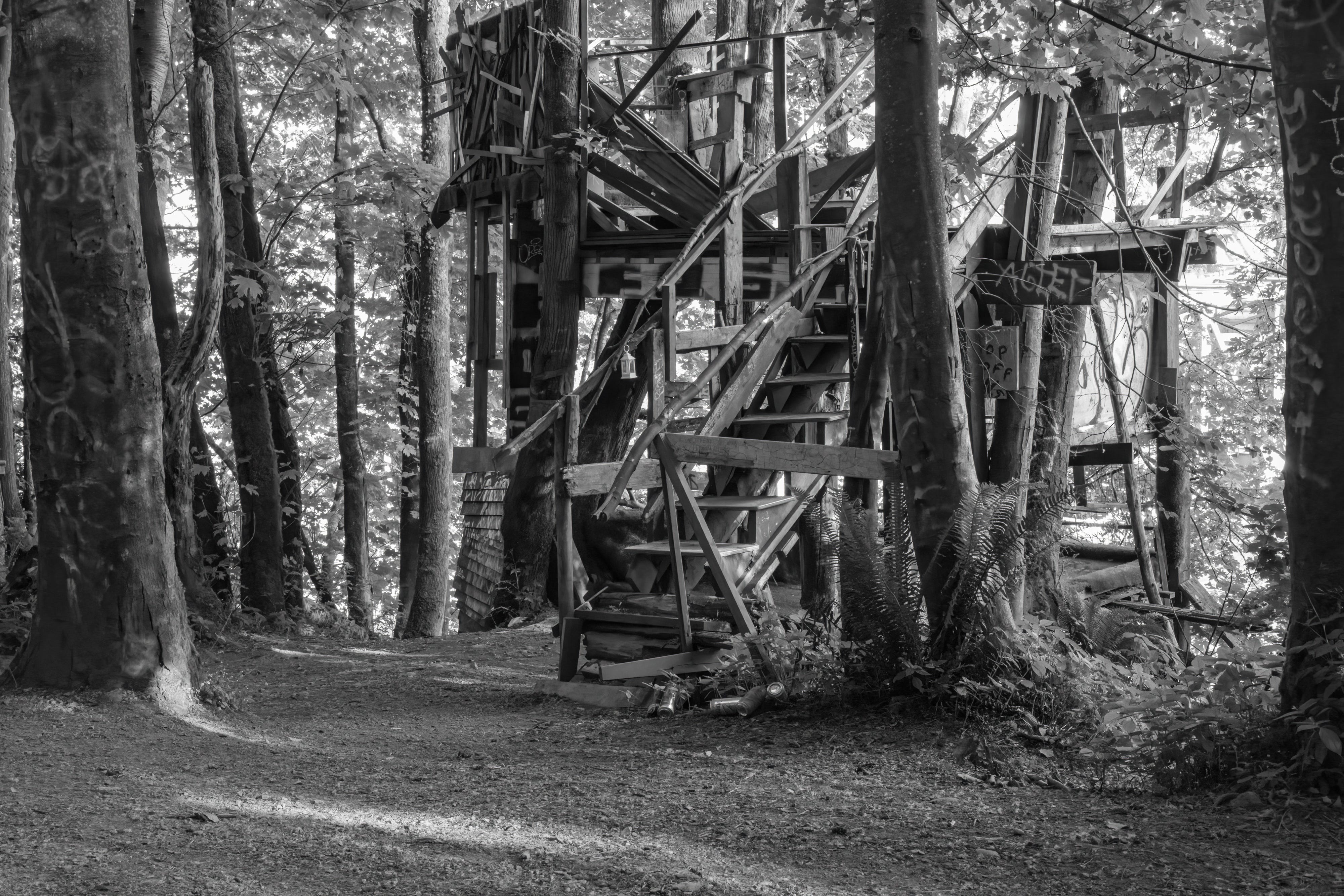
The tree fort in the woodland, surrounded by blazing light.
And then there is the tree fort. This is the most important element of the series, photographically and thematically. The fort is elaborate, multi-level, built with real carpentry effort. It has stairs, platforms, walls. It is a structure that took sustained collective work, not an afternoon but weeks, maybe a season. It is covered in graffiti. It sits at the edge of the wooded area, right at the cliff above the tracks, and from its upper platform the builders could see everything below: the trains, the pipelines, the utility vehicles, the Iron Workers Bridge over the Second Narrows. The fort is a response to the compression of the surroundings. It is also a form of childhood infrastructure built in the only available space, which is the space adults have forgotten about or find inconvenient: the margin between the rail bed and the gas easement, the leftover land.
\What I kept thinking, looking at the fort, is what it means to grow up where every visible surface is concrete, corrugated metal, or chain-link fence. What you learn to do is find meaning in the margin. Build in the leftover space. Climb to the only vantage point available, which is the edge of the cliff above the railway track, above the pipeline, above the place where adults park their inspection vehicles and drive away. The tree fort in my photographs is not an illustration of innocence. It is the thing itself: the physical evidence of teenagers doing what teenagers do, which is find the overlooked place and occupy it, make it theirs, make it a vantage point. The graffiti on the tree trunks around the fort is evidence that the overlooked place is also eventually a place the wider world finds. The beer cans at the base are recent. Someone is still climbing those stairs.
Honkasalo’s film understands this logic exactly. Simo has no space that is his own. His mother is emotionally unavailable, a passive figure whose helplessness reflects the systemic failure of the family structure within a harsh, impoverished environment. His older brother Ilkka, the closest thing to a guide he has, teaches him that the only thing you should be afraid of is hope, and frames emotion as a fatal weakness. To survive, one must be as hard and unyielding as concrete. Simo absorbs this. He has no other material to build with. What he builds with it is a version of himself that cannot receive kindness, a version that mistakes intimacy for threat.
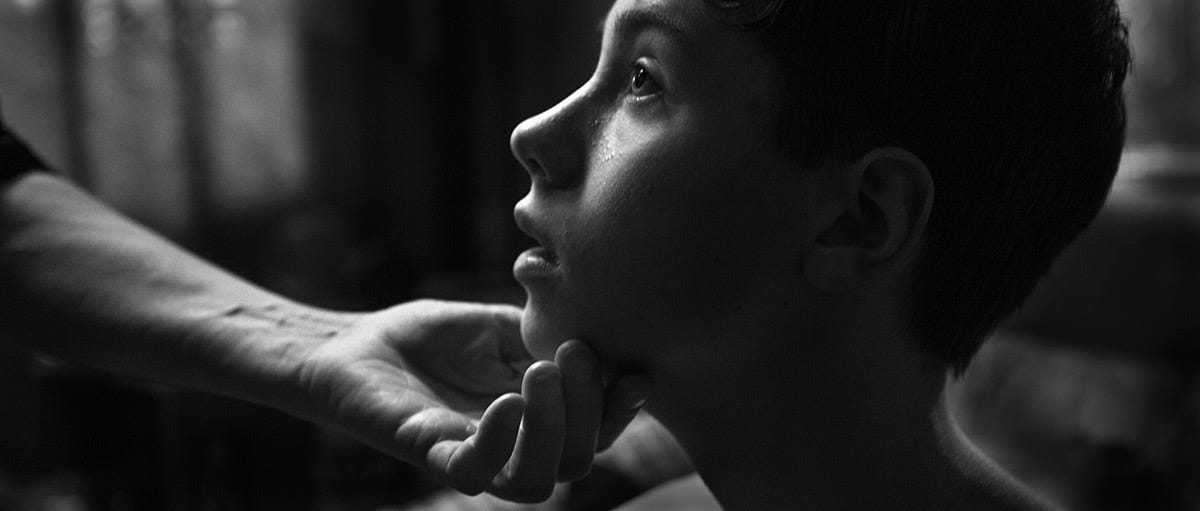
In Concrete Night, Simo’s inner life works the same way the fort does. He has visions of his own death. He worries about his mother’s cigarette smoking. He watches his brother with an intense mix of awe and desperate desire to please. He is doing what the teenagers who built the fort are doing, finding the only available ground and building something on it. The question is whether what you build in the margin, on the leftover land, at the edge of the cliff above the railway, is enough to hold.
In the last shot of the film, Simo is floating. His brother Ilkka arrives. The water closes. Black and white becomes, off and on, a monochrome of blue. I am surprised by the loss and lack of hope. Somewhere above the Second Narrows, the fort is still there.
References
Honkasalo, Pirjo, director. Concrete Night (Betoniyö). Bufo / Magic Hour Films / Plattform Produktion, 2013.
Saisio, Pirkko. Betoniyö. Helsinki: Tammi, 1981.
Mann, Sally. Deep South, Untitled (Scarred Tree). 1998. Tea-toned gelatin silver print, 40 x 50 inches.
Jenkins, William, curator. New Topographics: Photographs of a Man-Altered Landscape. George Eastman House, Rochester, New York, 1975.
Becher, Bernd and Hilla. Anonyme Skulpturen: Eine Typologie technischer Bauten. Düsseldorf: Art-Press Verlag, 1970.
Flinckenberg, Peter. Cinematographer’s website and biography. flinckenberg.com. Accessed 2026. Source for Honkasalo quotation on pictures and the unspoken.
Long-form essay writing takes a long time. Please support these essays by recommending them on Substack, restacking them, and feel free to repost.
What an engaging essay. The take on the fort is particularly compelling: "The fort is a response to the compression of the surroundings. It is also a form of childhood infrastructure built in the only available space, which is the space adults have forgotten about or find inconvenient."
I think this idea extends beyond environments defined by concrete or physical constraint. Even where space appears abundant—where the landscape is open rather than compressed—the same impulse persists. The fort becomes less a response to limited physical space and more a search for meaning beyond the forms of compression that shape our lives, whether social, emotional, or cultural.
In that sense, the desire to carve out a place of your own remains constant, regardless of how much room there is around us.