
The Blue House

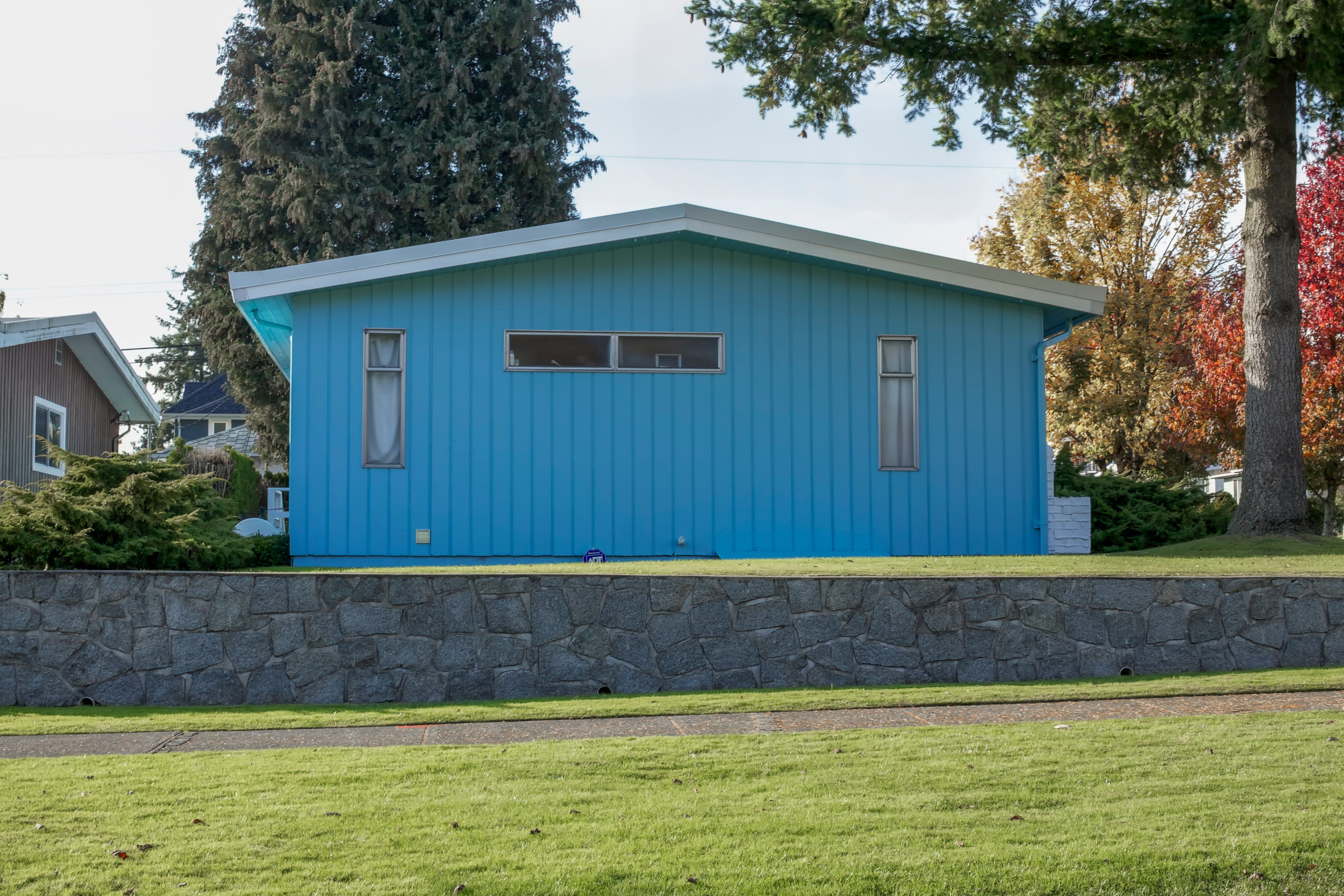
The house is a flat, saturated blue, board siding running vertical instead of horizontal, which is less common here and probably why I noticed the structure itself before I noticed anything else about it. A gable roof, white trim along the fascia, two narrow windows with sheer curtains behind the glass, and between them one long horizontal window low enough to look like it opens onto a kitchen counter rather than a room. A stone wall runs the length of the yard, irregular gray fieldstone with small drainage pipes let into it every few feet, and the lawn behind the wall is cut close enough to look combed, no patch left long, no edge left ragged. A small sign stands near the middle of the grass, close enough to the house that I could not make out what it said even blown up on my screen later. Behind the roofline, one tree had already gone red and gold while the rest of the block was still green, so I know now, checking the file, that this was taken in the fall.
It sits on a corner lot, nothing built up close on either side, a golf course taking up the whole view across the street, which means whoever designed it had more freedom than most houses ever get and used almost none of it. That long horizontal window is the detail that gives it away. I see it on houses all over this area, and it has always struck me as an odd choice: low, wide, more suited to a laundry room than anything meant to be looked out of. It reads like a plan pulled from a book, one of those pattern houses you could once order almost anywhere in the country. The designer never knew if it was going here, the Alps, or Vegas. I grew up in a house like it, made from a plan chosen out of a book the same way, dropped onto our lot the same way, with just as little idea of where it would land.
I photographed it from inside my car. I did not get out. I eased the car back and forth along the curb until the frame sat where I wanted it, four or five shots, then drove off. Some houses I photograph that way. Sometimes I park farther down the block and walk past what I’m going to take a picture of and turn around, taking the pictures as I head back to my car, but I never bring a tripod onto a residential street either way, I only shoot handheld. A tripod makes you much too visible. A camera out a car window barely registers as a person at all. Well, usually.
Property moves fast enough here that people get nervous about what a photograph might mean, whether it is the first step toward someone buying the house next door, tearing it down, and putting up something two or three times its size. I understand the fear even on the days it is not aimed at me. I am usually the opposite of what people are afraid of. I like these houses. I like that a house this plain, this out of fashion, this small, is still standing on a block while filling in around it are houses that do not fit the lot the way this one does. Plopped down or not.
I read J.B. Jackson in a college geography class once, not from him directly; he was not the one teaching it, just something assigned on a syllabus about how ordinary places get built and used, houses, fences, driveways, the whole unglamorous landscape most people drive past without seeing at all. It stayed with me longer than most of what I studied that semester. A yard, read that way, is not scenery. It is a choice somebody keeps making, over and over, about how much of themselves they are willing to let the street see. It’s them getting dressed up for Sunday church, or not getting dressed up and going fishing instead.
I drove past this one more times than I photographed it before I posted anything. There was never a basketball left in the yard. Never a bike against the porch rail. Never a shade pulled up crooked, never a hose left uncoiled by the spigot.
Once, the garage door was up, and I could see inside it the way you see the inside of anyone’s garage from a moving car - slow, but still too fast, a few seconds, but it was enough. Tools hung on a pegboard, each one with its own shape drawn around it in marker, a hammer-shaped outline where the hammer went, a drill-shaped outline where the drill went, so that if either one went missing you would know it in the time it takes to glance at a wall. Screws and nails were kept in small jars, sorted by size, lined up like something in a hardware store rather than someone’s garage. I grew up with tools left in a fort in the woods behind our house, in a treehouse two doors down, on a picnic table that stayed outside from May to September getting rained on. Nothing in that garage looked like it had ever once been left where it did not belong.
There is a geographer, Yi-Fu Tuan, who put more plainly than I ever have what I think I was actually looking at, he said: a space becomes a place only through care, kept up over and over, never once let go of.
I have seen the same instinct dressed up differently in other yards on other streets, hedges let grow to twenty feet on every side, tall enough to wall off the sidewalk, the neighbours, anyone walking a dog past on a Tuesday evening. Different methods used to separate themselves from everyone else. Same idea sitting underneath it.
When I posted the photograph of The Blue House, what I wrote was short. I said I loved the photograph but, surprisingly, the house made me uncomfortable, that it seemed oppressive, that I suspected growing up there had meant following more rules than the house next door ever asked of anyone.
A man I did not know wrote back. “Why don’t you mind your own business? What are you taking pictures of other people’s houses for?” That was only the start of it. He kept going, in comments and then in messages, sharper each time, until I did the only thing that felt available, which was to block him. I do not block people over a disagreement about a photograph. This felt like something past disagreement.
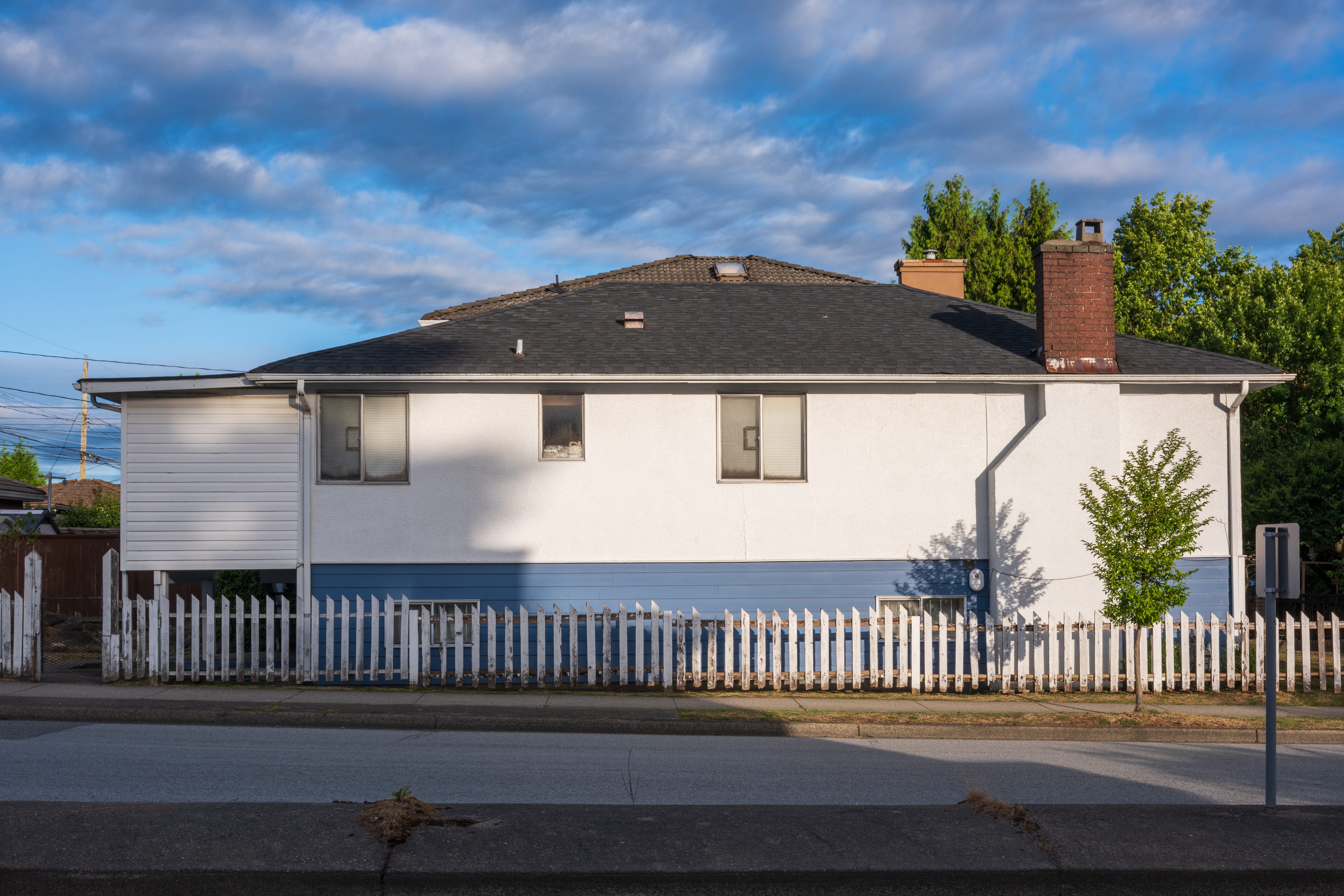
Another house not far from the Blue House, which
every morning catches the morning light. Houses here often seem to face away from the street, or at least not directly.
I have thought about him more than I have thought about the house since. Whatever he was protecting was not his own yard. As far as I know, he had no more claim on that blue house than I did, a stranger on a screen defending a stranger’s front lawn. But something about being looked at too closely, and commented on where other people could read it, hit him the way a missing hammer must hit the man who owns that pegboard. Not a small thing. But it’s the small things that build up into major disasters.
I don’t think that is a coincidence. That house was built and cared for to announce, in a single glance, the exact second anything was out of place. It told everyone walking by who lived there. You didn’t have to knock on the door and go in. It turned out the man defending it, or defending the idea of it, was likely built to work exactly the same way.
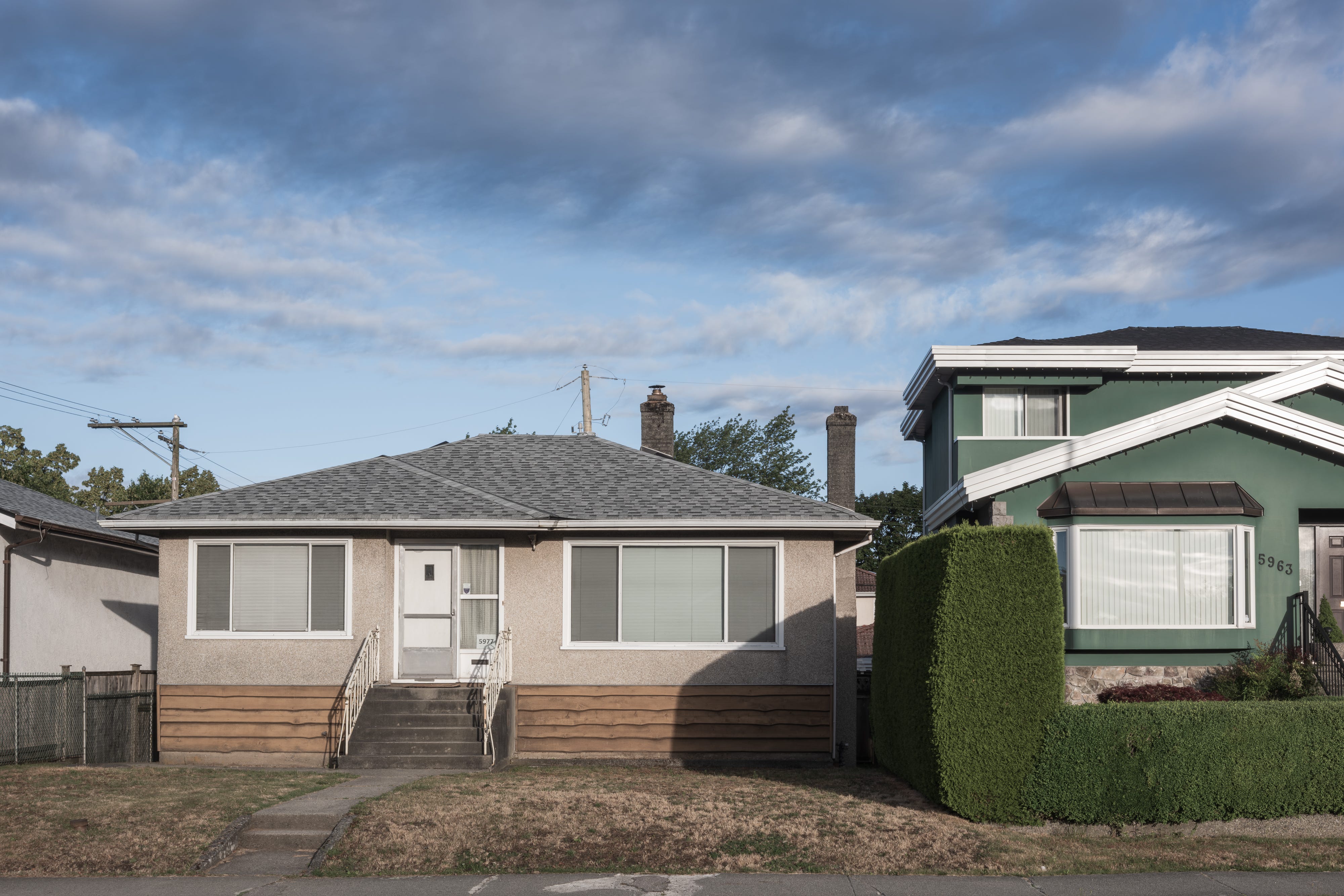
Two Houses in Different Worlds.
Please, if you can take the time to restack the essay, it would be of great help.
I like these houses. Esp the blue house with its two greens sloping below it. I’m sorry you got such grief for imagining its backstory.
Once again, I'm grateful for your writing, Jim.
I had to read this twice. On the first reading I really disliked your description of all the details in the photograph. On the second reading I realised that this was a description of why you had photographed the house in the first place and the essay flowed on from that. Curiously, my neighbours two doors up had a tree house, and we all had bush (woods as you would say) behind our houses - and here we both are, photographing houses like the ones we knew growing up. I walk to make my pictures and have been asked about what I was doing only twice, both times ended up in pleasant conversations, one of them with a portrait of the owner of a highly manicured house and yard! Thanks again for the essay. Love your writing.