
Suchness and Objectivism
A few notes on Robert Adams, poetry and "Art Can Help"

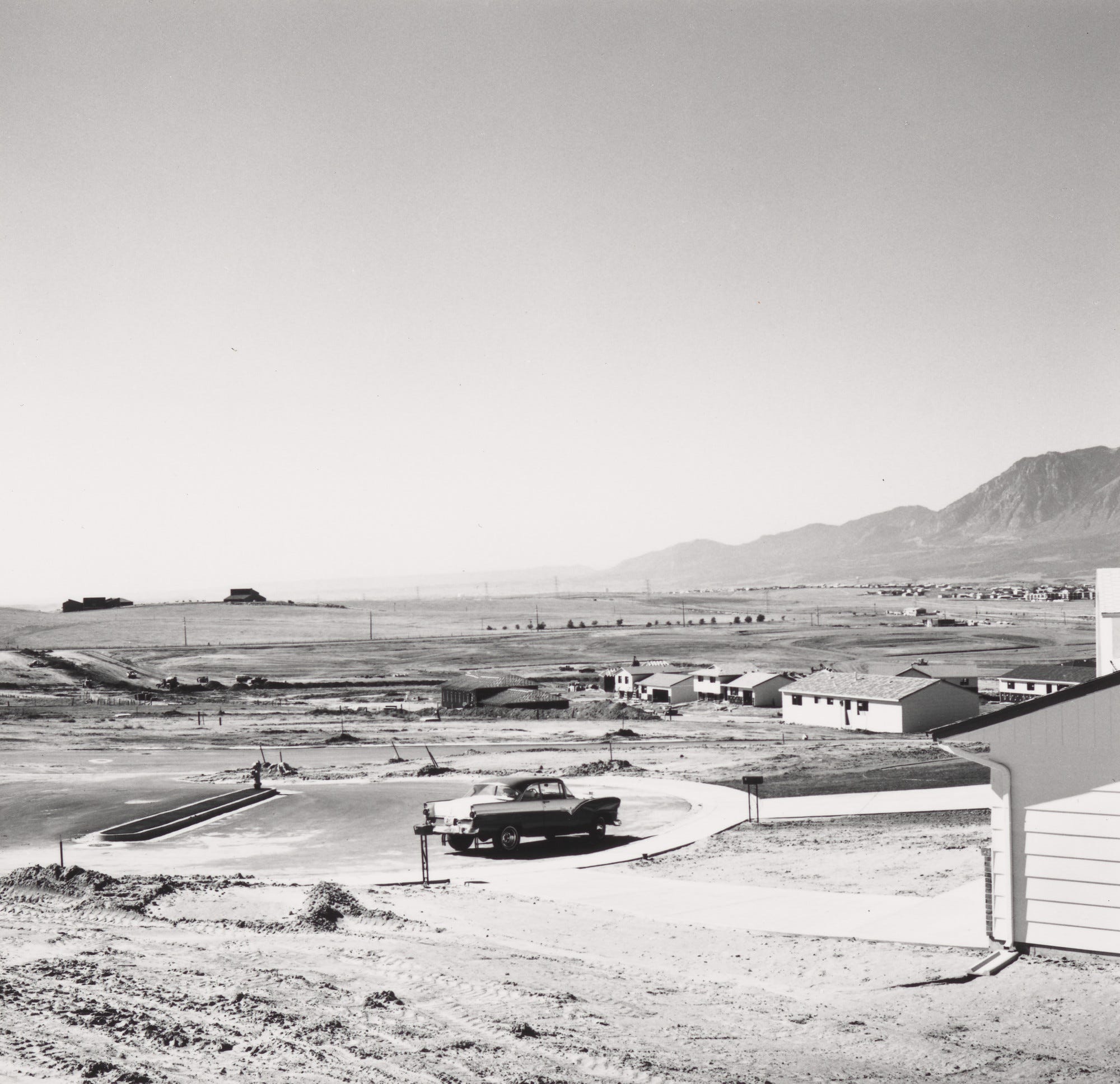
Robert Adams took a series of photos in Colorado Springs in about 1968. Above is one of several photos of houses, something I too have been working on in a long-term project. In Adams’s photos, the houses are freshly built, sitting on dirt that hasn’t grown grass yet, mountains behind them, doing nothing in particular. MoMA has several of these prints. So does the Victoria and Albert. In spite of what I’m going to say, honestly, I wish I had prints of these.
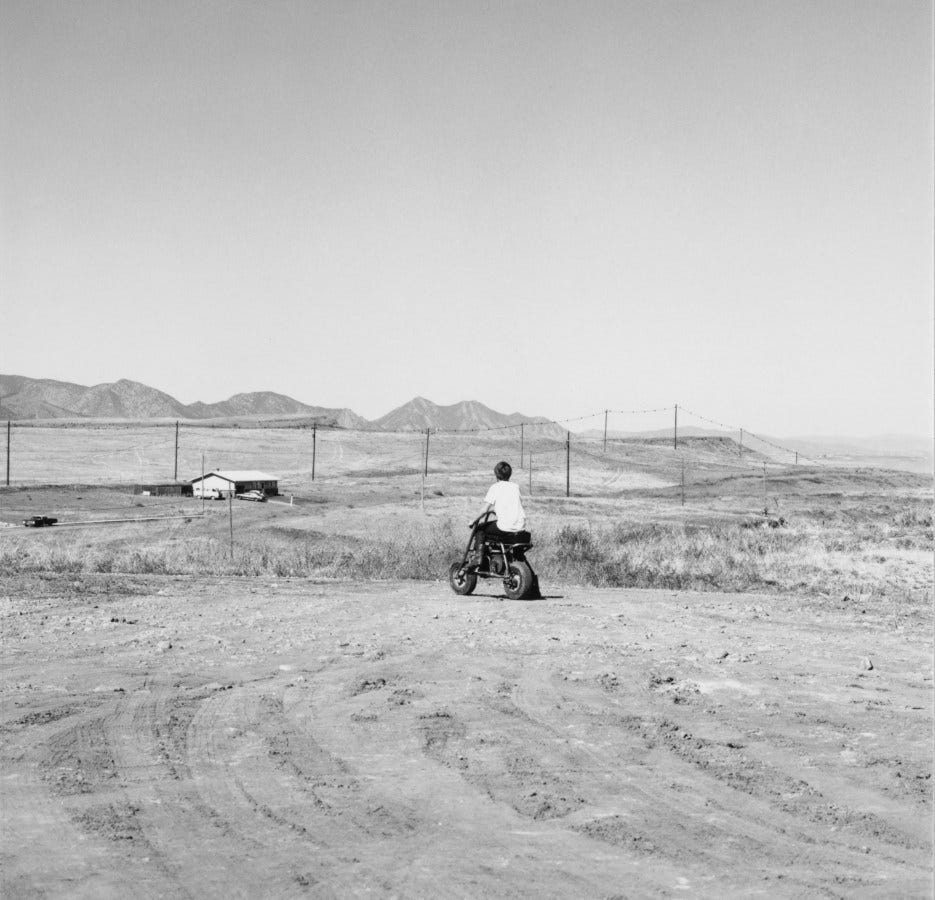
Nobody in these pictures is doing anything much, and nothing in the pictures asks you to feel anything in particular. Many are perfect examples of what we call an open picture, one that stays open to whatever interpretation or input a viewer brings to it rather than closing down toward a single meaning, the tract houses themselves being as plain an example as you could ask for, since nothing in them tells you what to feel. By every account except the photographer’s own, this is about as objective as photographs get. Some of these images would end up in a little book called “The New West,” the same body of work that got Adams included in the New Topographics show in 1975, a group that is still, fifty years later, the reference point critics reach for when they want to describe photography with no metaphor in it at all. Deadpan. Clinical. Cool. Those are the words other people use for Adams’ pictures, not words he uses for himself. To him, a good photograph seems to also need to be a good metaphor. What Adams doesn’t want is to be called an “objectivist.”
Still, even though I don’t fully understand his objection, I turn to his photos in times of confusion and doubt. That’s the best descriptor I can give you about my mental status right now. Confusion and doubt. And these pictures make me feel good, at least about art.
In his book, “Art Can Help,” he writes about beauty as something that is “never less than a mystery, but it has within it a promise.” He says it’s the artist’s responsibility to share with us a gift for metaphor. But to me he is telling us, in his own sentences, that photographs like the tract houses aren’t enough on their own, that they still need mystery, need promise, need metaphor to do their real work. Read that while you have one of his books of his photos in front of you, and something just doesn’t line up. These are pictures that usually refuse to editorialize, made by a man who insists in prose that still, “art” has to do just that.
Now I don’t think the interesting part here is that he contradicts himself. People contradict themselves constantly, and it’s rarely worth remarking on because it’s our nature. What’s interesting is what happened to the photograph once Adam’s sentences got loose in the world and did their work on how other people see it.
His last major catalogue, “American Silence,” made cooperatively with the National Gallery in 2022, organizes his career into three sections; one of them is called Tenancy. The wall text and the reviews talk about the reverential way Adams looks at things, the almost palpable silence in the pictures. Terry Tempest Williams wrote the afterword and it’s a great read, it will inspire you. Let’s just note that none of the language it relies upon originates in the tract houses. Adams put that into the world in his prose, and the museum and the critics picked it up, and now his writing has seeped into the grain of his photographs, whether the photographs asked for it or not.
A picture of a half-built house in the dirt gets talked about like it’s the Book of Genesis, not because the picture changed, but because the talk around it did. To me, that’s the subject here. Not that a man disagrees with his own work, but that a photograph can be quietly rewritten by the language surrounding it until it means something it’s never claimed to be.
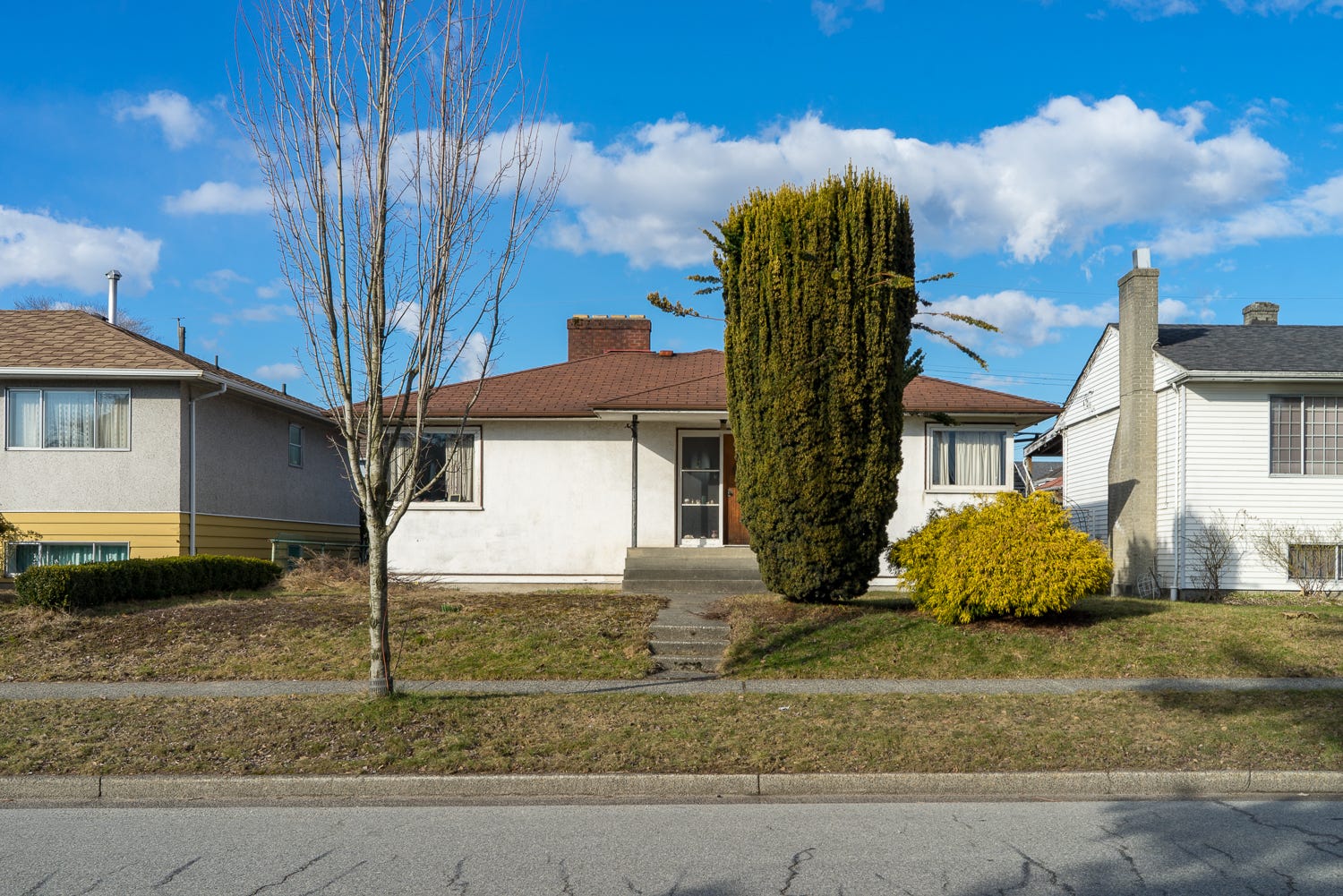
One of my own photos of a house.
I keep circling back, while I think about this, to a much older but similar argument that already happened once, in poetry, long before anyone called a photograph objective or otherwise. There’s a haiku everyone knows even if they don’t know who wrote it or where they heard it. It goes like this: Old pond, a frog jumps in, the sound of water. That’s the whole poem. No comparison, nothing standing in for anything else. Basho, the poet, doesn’t tell you the pond is like memory, or the frog is like time passing. He gives you a place, an action, a sound, and stops talking. Let me tell you, when I reread that one day, I thought to myself, “I want to make photos just like that poem.”
There’s a wrinkle worth letting you in on, which is that Basho apparently didn’t see this happen, the frog was an assigned seasonal theme at a gathering held at his own hermitage. So the poem is a made thing pretending to be a report. Sort of like a staged photo. A Jeff Wall with frogs. But that doesn’t weaken the point so much as sharpen it. Restraint like that is a discipline, not an accident of what happened to be in front of Basho, or Adams.
Basho has another poem many people know, about a temple bell. As the bell fades, the scent of the flowers takes up the ringing, evening. In the original Japanese (Romaji): kane kiete / hana no ka wa tsuku / yuube kana, in translation by R. H. Blyth: The temple bell dies away / The scent of flowers in the evening / Is still tolling the bell.
That poem works a little against me, since sound turning into scent is its own kind of figure, bells don’t actually smell like anything, so even Basho, at his most stripped down, allows himself one seam of connection between two senses that don’t belong together. Maybe that’s the answer to just how far objectivity can really go, not that metaphor disappears completely, but that it gets rationed down to almost nothing, one small connection instead of a whole architecture of comparison. I would say this poem “leans” into objectivity.
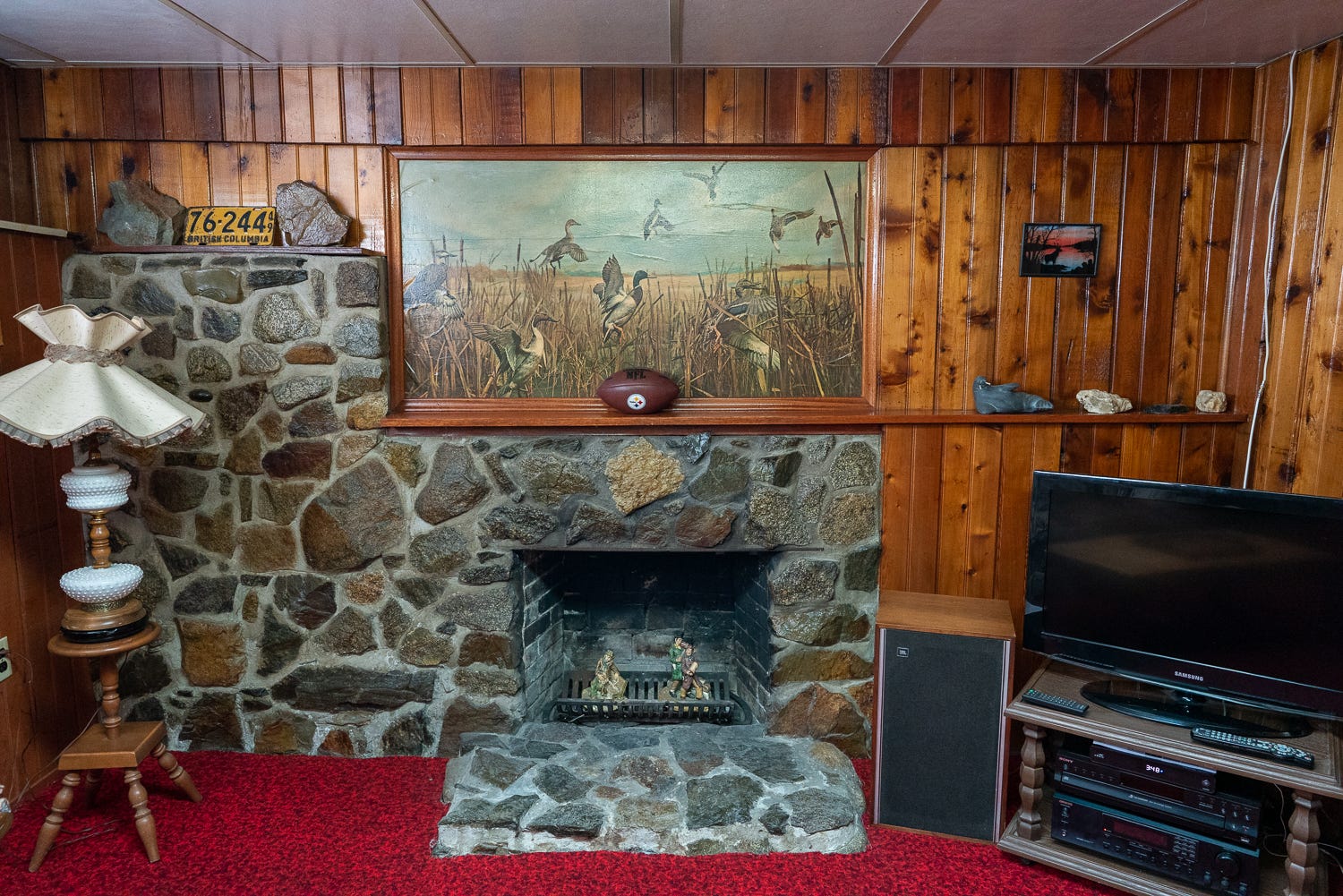
An interior from several years ago. A house for sale.
A poet named Masaoka Shiki tried to make this a rule rather than an instinct, at the end of the nineteenth century, when he reformed haiku around something he called shasei, “sketching from life,” focused on plain observation of the natural world instead of the old habit of leaning on centuries of literary reference. He got the idea, apparently, from a painter friend who’d studied Western realism and thought art should faithfully reflect whatever it portrays. R.H. Blyth, the critic who did more than anyone to bring this tradition into English, argued that haiku refuses the whole Western instinct to rank subjects into poetic and unpoetic, sacred and trivial, and instead aims at something he called suchness, a thing presented as it is, standing for nothing beyond itself. Roland Barthes came at the same idea from outside the tradition entirely, as a Frenchman looking at Japan, and called haiku a breach of meaning, a form that only designates, that says “it’s thus” and nothing more.
What I didn’t expect, going back through this, is that Barthes wrote almost the identical sentence about photographs a decade before he wrote it about haiku. In an essay on the press photograph, he argued that a photograph carries a message without a code, a first layer of pure denotation, the thing itself, prior to whatever second layer of connotation gets added by lighting or composition or caption. That’s the same claim, applied to a different medium. And there’s an actual American precedent for using the word objectivist the way I want to use it, which surprised me.
A small group of poets in the 1930s literally called themselves Objectivists, Louis Zukofsky, Charles Reznikoff, George Oppen, with William Carlos Williams orbiting close by. Zukofsky’s manifesto talked about sincerity as attention to the object rather than to the poet’s feelings about the object, and objectification as the poem taking on the solid, made quality of a thing rather than functioning as a container for symbolism. Williams gave it five words. “No ideas but in things.” None of them thought rejecting metaphor was the easy way out, they thought metaphor itself was the easy way out, a shortcut past the harder work of getting the actual thing onto the page accurately enough that it didn’t need one.
Which brings the argument back around to photography, where the same case has been made again and again by people with no interest in poetry at all. André Bazin, writing on cinema and photography in the 1940s, said “the camera involves no human hand between the object and its image, that for the first time an image of the world forms automatically,” without what he called the “creative intervention of man,” which is what gives photography a claim to objectivity that painting, however realistic, can never fully make.
The Group f/64 photographers said almost the same thing from behind the camera instead of in front of it with theory, defining pure photography, in their 1932 manifesto, as “possessing no qualities of technique, composition, or idea borrowed from any other art form.” Weston put it more simply saying that “the camera should be used for a recording of life, for rendering the very substance and quintessence of the thing itself.” John Szarkowski, running photography at MoMA, built a whole 1978 show around a distinction that maps almost exactly onto what bothers me about a lot of art now, mirrors versus windows, a mirror being subjective, self-expressive, about the artist’s own consciousness, a window being objective, concerned with the world outside the artist rather than the artist’s feelings about it. Walker Evans refused the word documentary outright, calling it sophisticated and misleading, and said he worked in a documentary style instead, one built on transparency and the deliberate withholding of symbolism.
And the New Topographics exhibit, the very show that made Adams’ reputation, is the show art historians now point to as the clearest example of photography with the metaphor deliberately drained out of it. Which puts Adams in the odd position of having built his career inside the movement that best proves the argument he spends his prose resisting.
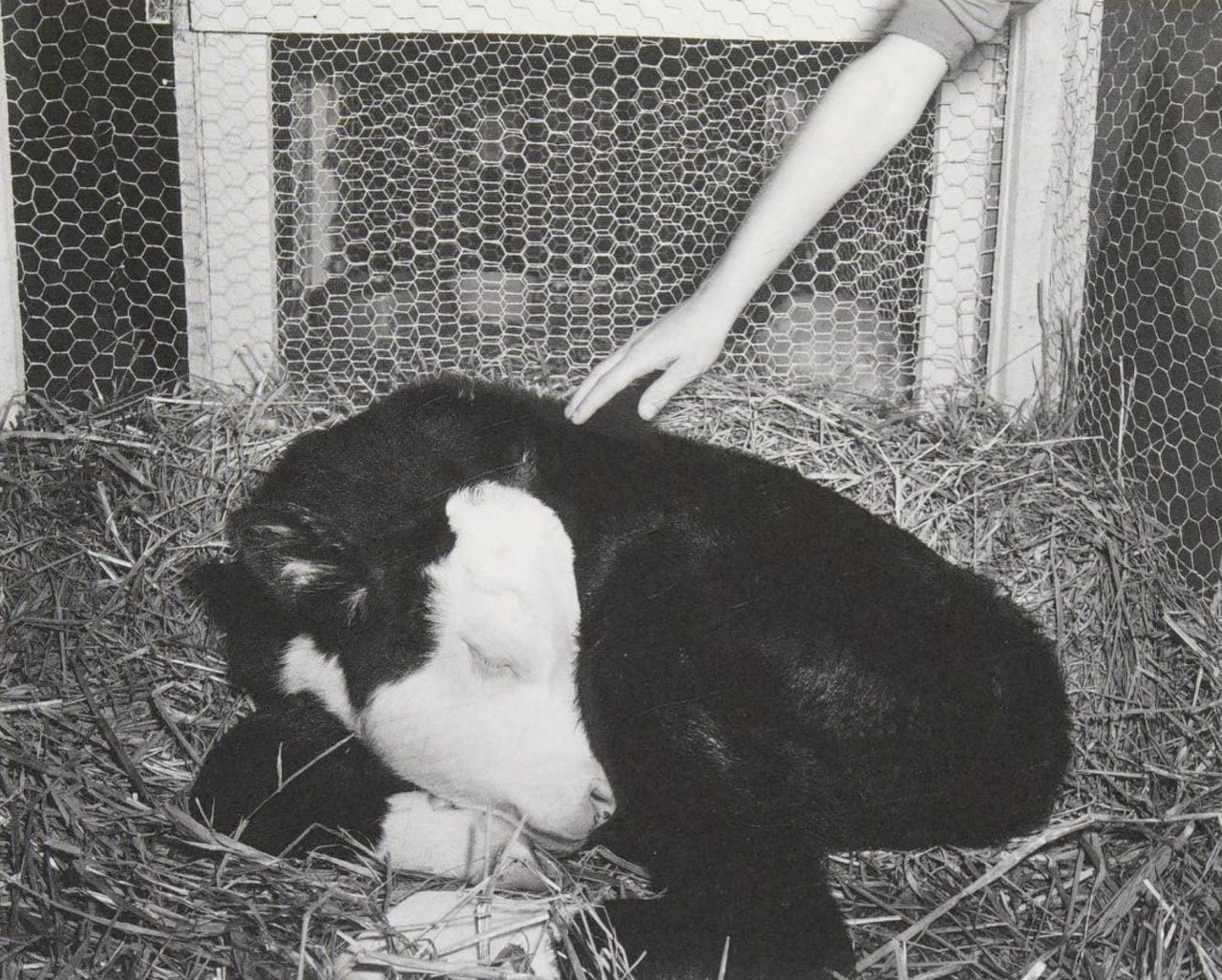
Nicholas Nixon, West Springfield, Massachusetts 1978
All of which was on my mind when I got to the photograph Adams writes about on pages 43 through 45 of “Art Can Help,” a picture by Nicholas Nixon, titled simply “West Springfield, Massachusetts,” from 1978. It shows a hand reaching out toward a calf. Adams reads that outstretched hand as an echo of Michelangelo’s ceiling, the hand of God reaching for Adam. Nixon and Adams were both in that same 1975 New Topographics show together, which makes the comparison stranger, not less strange, one deadpan photographer reading Sistine Chapel scale meaning into another deadpan photographer’s most ordinary picture. Susan Sontag has a line I keep thinking about here, from the opening pages of “On Photography,” that to photograph is to appropriate the thing photographed. Reading the Sistine Chapel into a hand reaching for a calf feels like exactly that, appropriation, claiming an ordinary moment by inflating it, rather than finding out what it actually was.
What it actually was, is the Eastern States Exposition, the Big E, held every fall in West Springfield since 1916, when a man named Joshua Brooks founded it explicitly as an agricultural and educational institution. All six New England states have their own permanent building on the grounds. It runs seventeen days, opening the second Friday after Labor Day. I’ve been. It is not a place that needs the Sistine Chapel. It’s a fair, with a purpose you can look up, a history you can date, buildings you can walk into that belong to specific states for specific reasons. None of that is a metaphor. It’s just what was actually there, and it would have told a reader more about the photograph than the ceiling of a chapel four thousand miles away and four hundred years in the past. It’s where I grew up. I went there in a yellow bus in grammar school, took the public bus in high school, and took my kids there when they were young. It was about the things themselves.
There’s one more piece of this I keep coming back to, which is Adams’ claim that art of this kind “encourages gratitude, engagement, personal and civic consequence.” I want that to be true. But T.S. Eliot got there, in his own way, a century ago, and landed somewhere much less certain. In “Tradition and the Individual Talent,” written a few years before “The Waste Land,” he argued that good poetry isn’t self-expression at all, that it’s an escape from personality, a continual extinction of personality, the poet acting as a kind of catalyst rather than a person putting private feeling on display, which is close to my own complaint about how personal, how “about me,” so much recent art has become. And “The Waste Land” itself ends with a line everyone quotes, these fragments I have shored against my ruins, usually read as the sound of a civilization failing to hold together after a war, art scraped up out of wreckage rather than any confident civic promise. Eliot later denied that reading, said critics who called it the disillusionment of a generation had it wrong, that he may have expressed their illusion of being disillusioned but not his own intention. I find that denial almost more useful than the line itself, since it shows how little control an artist has over what his or her own metaphors end up meaning to other people, once they’re out of their hands. Which is its own argument against depending on metaphor to do civic work reliably. You can’t guarantee the promise lands the way you intended it to.
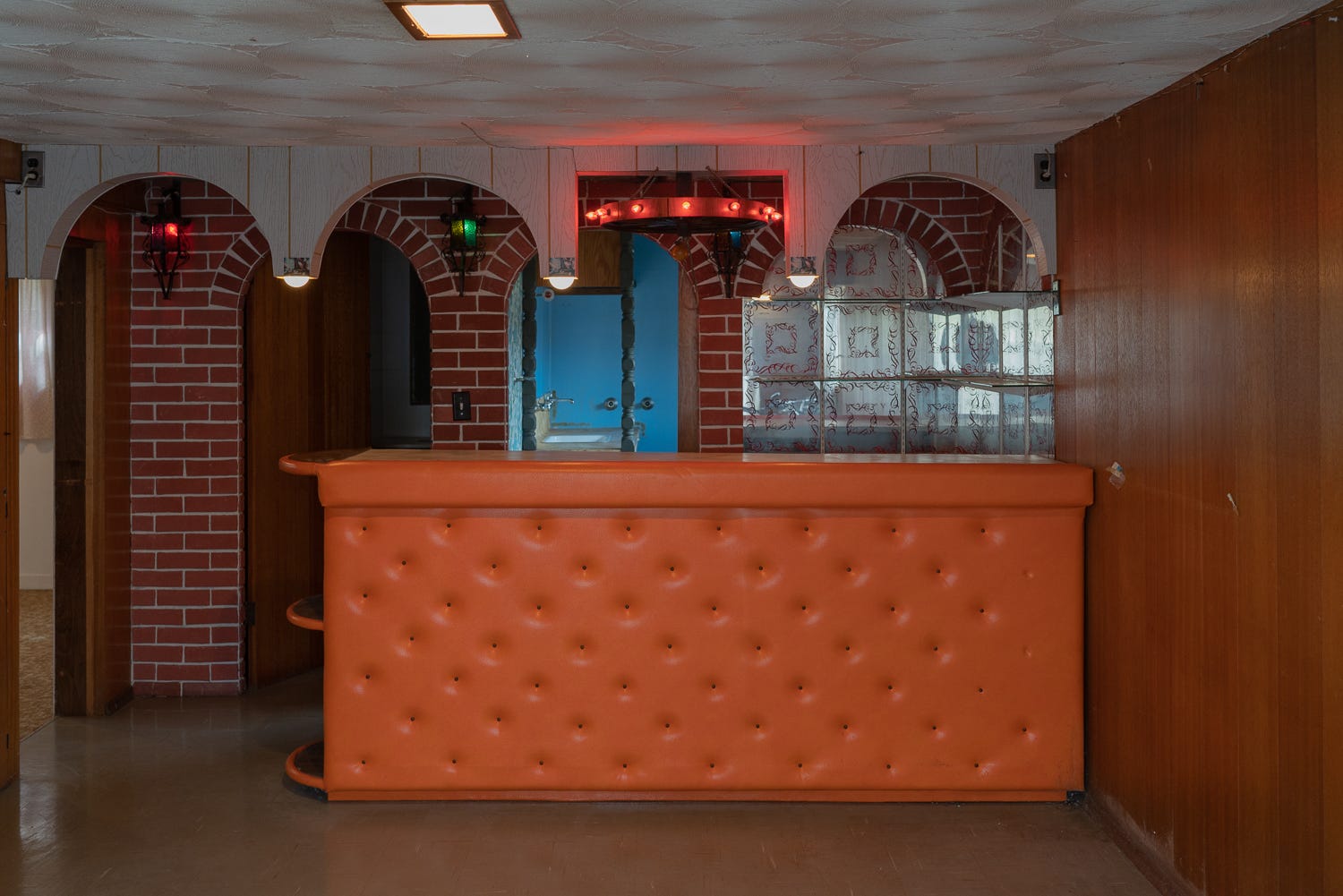
Another interior of a house for sale.
I want to end on that word again, Tenancy, because it turns out Adams used it himself before the National Gallery borrowed it. He published a book by that exact title in 2017, forty black and white photographs made on the Oregon coast, tree stumps left on the beach by clearcutting, stretches of shoreline set aside for birds that had been thought gone from there. And he wrote short prose passages to go with the pictures. Which tells me something more honest than anything in “Art Can Help.” Here is the photographer whose most famous pictures need nothing added, no mystery, no promise, no metaphor, adding his own words to his own late photographs anyway, as if even he didn’t fully trust the tract house method to carry the weight alone. I don’t have a better conclusion. He made the case against himself better than I could.
—————————————————
Please support my writing by subscribing, re-stacking, and recommending my essays on Substack. Your efforts are appreciated. I enjoy comments and a back-and-forth conversation, but I am here for conversation; welcome disagreement, but please, keep it civil.
Image Credits and Fair Use
Images are reproduced here for purposes of criticism, commentary, and scholarship under principles of fair use (U.S.) and fair dealing (Canada, UK, and Europe). Copyright remains with the respective artists, photographers, estates, or rights holders. If you are a rights holder and would like an image credited differently or removed, please contact me and it will be addressed promptly.
I read this and had some thoughts. Then I happened on an older piece by Noah Waldeck (Subjectively Objective) about that "New Topographies: show. Some tidbits I found interesting was the Jenkins (the curator) basically invented the term and curated the show based on the photos being "stylistically anonymous" and that the show was widely panned (even hated).
But on to the meatier bits.
One of the things everybody seems to get hung up on is the objectivity of the images. What strikes me is that there is an obvious parallel with memory. Memory is *never* objective and eye-witness reports are usually terrible at establishing facts. Every witness sees the event through the accumulated experiences of their lives and that goes for those New Topographies photographers. Every one of those photographs meant making conscious decisions among many possibilities and those decisions stemmed from the photographers' lived experiences.
I kind of love the fact that Elliot was coming around to the very thesis of "The Intentional Fallacy" (which has to be one of the best titles ever) which claims that once release, the art work exists on it's own, cleaved from its originator; that is has meaning apart from any original intent. I've got thoughts swirling without form regarding that but feel like I'll bring it back around to your comments about Adams and metaphor.
I like the idea of dialectic, where two competing ideas can hold truth simultaneously. You said that people contradict themselves all the time. I rather think that people want to see things objectively but because of basic human nature are incapable. Adams is exactly correct in photography as metaphor -- an ostensibly objective form that is continuously interpreted.
Another really engaging piece of writing - thanks. You have a great way of letting us follow the path of your thoughts as you try to work something out.
For myself, I've always had a nagging doubt about the claims of objectivity proposed by The New Topographics photographers and others. It stems from my feeling that every photograph, even a CCTV security image has an intention behind it that is there before it is made. Most obviously, framing and timing will be the result of a personal process, even if the equipment performs its task with absolute disinterest.
Walker Evans, for example, documented his world but clearly made subjective decisions about what he wanted to put in his dossier. Robert Adams chose where to stand and what to include in his frame and what to leave out. These are not objective actions.
Although none of these people sought metaphor or grand, extrapolated meaning in their images, it was inevitable that, once out in the world, such things would be attached to them.
It's a sort of curse of the medium, that a photograph is expected to have a reason to exist, a reason why the photographer made it. That's probably a legacy of its primary role as a means of communicating information, but it does tend to mean that when people look at a photograph, they want it to mean something and if the photographer hasn't signalled any particular meaning, the viewer will very likely imply their own.
It's certainly a can of worms!