
Stumbling Over The Vernacular
a fairly long discussion of the real nature of the vernacular

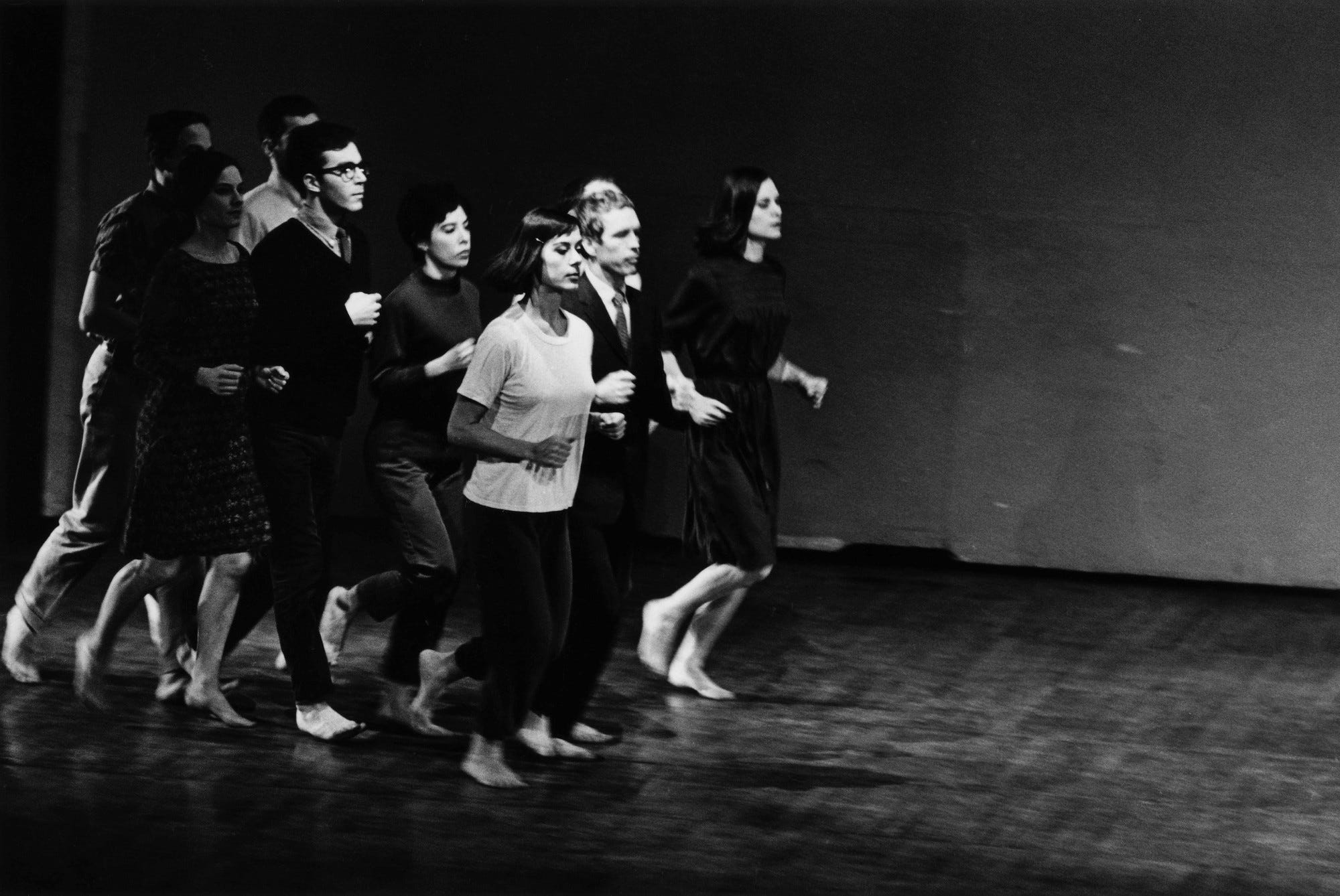
Above: Yvonne-Rainer Dance Group
When I write, I usually start by writing a lot. 5-10 pages on a topic. Everything I am thinking about, everything I know. A lot of it comes from notes I take during the day on 4X6 cards, but I’m trying to move to using a small notebook. A change in process is very disruptive and takes time to get used to. I like the cards, but they seem to get lost and hide on me. Then the work begins: editing. Edit = cut, cut, cut, copy, move, paste…until I’m somewhere around 3-4 pages. Sometimes, like today, a long piece gets written, and after starting to edit, I realize I need to start from the beginning again, with a new outline. Sometimes, a lot of the time, I take what I’ve written and give it a title that clarifies what’s in it, and then put it into a folder with dozens of others, where, after a lot of effort, it sits. For the past few months, I have also printed a hard copy and kept it in a 3-ring binder, where I can easily find it and reread it. Today I’ve written a long one, one with too many facts, too much information, too many words, but somehow, every time I cut something, the essay seems to lessen in value, and I put it back. I honestly think this one is something better said and discussed than written out. Maybe even demonstrated. At any rate, my final decision is to leave this piece as is. It comes down to this: I honestly think anyone practicing in the arts should know modern and contemporary dance, as it’s a place where all sorts of artists work collaboratively. Painters, sculptors, print-makers, musicians, dancers, choreographers, writers, poets…everyone. So, take a look. Maybe make a hard copy. Maybe make a hard copy and start your own 3-ring binder.
The Essential
“Boring.” That is the word I hear most often from people trying to describe their landscape photos. I hear it from photographers who are about to show me their work, from students explaining what they have chosen to photograph, and from people at talks who want me to understand what they are working on. They say it quickly, almost casually. “Boring,” “Mundane,” “Unimportant stuff,” “Trivial,” “Pedestrian,” “Meaningless, but I’m going to make it meaningful.” They say these words the way someone might mention a credential, as though the boringness of the subject were itself evidence of the seriousness of the photographer. No one seems to be saying deadpan anymore, but I think they often mean deadpan.
This is where the trouble starts. Vernacular is not boring material waiting to be rescued by a talented eye. The vernacular is essential. It is everywhere and ordinary precisely because it carries the weight of how people actually live. It’s not a lesser version of something more important. It is the primary thing itself.
J. B. Jackson
J.B. Jackson understood this. Jackson founded the journal Landscape in 1951 with the subtitle “Human Geography of the Southwest,” and spent decades driving the back roads of New Mexico writing about motels, roadside diners, mobile homes, and the kind of ordinary houses that nobody put on the covers of design magazines. He was not really cataloguing the overlooked. He was arguing that the ordinary American landscape was where you went to find out what was actually happening. These things were interesting not despite being ordinary but because they were ordinary, because they had been shaped entirely by necessity and use rather than by ambition or aesthetics.
Jackson’s idea spread. Robert Venturi and Denise Scott Brown went to Las Vegas in 1968 to study the strip, the signs, the parking lots, the ordinary spectacle of a commercial landscape built entirely for function and desire. The Bechers, Bernd and Hilla, photographed water towers, blast furnaces, and winding towers, the industrial vernacular of the Ruhr Valley, in a systematic and deadpan way that removed drama almost entirely.
Robert Adams photographed the suburban edges of Colorado, the Front Range development, the new houses and bulldozed land and parking lots of what had been open country. None of them were documenting the overlooked as an act of charity toward overlooked things. They were asking what ordinary things actually mean, and how you make that meaning visible without imposing it. That last part is the part that gets lost. Too many people want to impose their ideas on us.
Why I Am Talking About Dance
I am not a dancer, not a dance critic, not a dance historian. The last time I danced was in the sixth grade, on rainy days when we were not allowed outside for recess and had to do square dancing in the gym. I suspect this qualifies me as well as most people who write about these things.
I talk about dance when I am teaching because in photography, the vernacular can stay comfortably vague. You can point at a print by Robert Adams and say, “That,” and people nod and think they understand. In dance, the question has to be answered in real time, in a room, in front of people, in a body that is either doing something or not doing something. The movement either holds your attention or it does not. And if it does not hold it, everyone in the room knows it immediately.
When students think about the vernacular only in terms of photography, they think about it in terms of subjects. They think: this kind of thing is vernacular, therefore I will photograph this kind of thing. They photograph it, and the photographs don’t hold, and they don’t understand why. The subject did everything it was supposed to do. It was ordinary. It was overlooked. It was vernacular. Why?
Taking the idea into dance shows you that the vernacular was never about the subject. The subject is where you start. What holds the subject in place is something else.
Black Mountain College, 1952
The move toward ordinary movement in dance did not begin with a single person or a single decision. It began as a series of arguments, spread across decades and disciplines, about what a body is for.
When Isadora Duncan, the first dancer I ever knew about, turned to Greek vases at the end of the nineteenth century for inspiration, she was looking for a body outside the rigid grammar of classical ballet, a body that could move with gravity and breath and what she believed was a natural continuity. The body she wanted was a vernacular body, shaped by use and nature rather than by the artificial conventions of a theatrical tradition. The 1968 film Isadora, directed by Karel Reisz and starring Vanessa Redgrave, is not a documentary, but it captures what she was arguing.
The decisive shift comes in the early 1950s, and it comes in two rooms at almost exactly the same time.
One room is Black Mountain College in North Carolina, where the choreographer Merce Cunningham and the composer John Cage were working. The other is a concert hall in Woodstock, New York, where, in 1952, a pianist named David Tudor sat down at a piano and did not play. He did not play for four minutes and thirty-three seconds. He closed the piano lid at the start of each of the three movements and opened it at the end. The music was whatever sound was in the room. Rain on the roof. People shifting in their seats. The creak of the building. Cage called the piece 4’33”. Most of the audience was furious. Some of them drove home in silence, and the silence in the car was also 4’33”. That is the point.
What Cage was doing with silence, Cunningham was doing with movement. Dance separated itself from music and from narrative. Movement was no longer there to express an emotion or illustrate a story. It existed alongside other elements, independently, structured through time rather than driven by feeling.
Also at Black Mountain, and then in New York, was Robert Rauschenberg. He was twenty-seven in 1952, and he was asking the same question Cage and Cunningham were asking, but with stuffed animals and truck tires. His combines, assemblages that fused painting with ordinary objects, reached their fullest statement in Monogram, made between 1955 and 1959: a stuffed angora goat standing upright, an automobile tire circling its middle, mounted on a painted platform. You stand in front of it in a museum and cannot quite decide what category it belongs to. That uncertainty is the work. Rauschenberg also made sets for Cunningham’s company from 1954 onward, and performed in some of the early Judson pieces. He was not adjacent to this argument. He was inside it.
Isamu Noguchi had been inside it longer. From the late 1930s through the 1980s, Noguchi designed sets for Martha Graham, more than twenty major works, including Cave of the Heart in 1946 and Seraphic Dialogue in 1955. What Noguchi understood is that sculpture placed in a space where a body moves becomes something different from sculpture placed in a gallery. The dancer activates the object. The object changes what the movement means. This is the bridge between what Graham was doing with the body and what the abstract expressionists, and then the postmodernists, were doing with surface and material. Noguchi built it out of bronze and wood, and Graham danced through it.
The Vacuum Cleaner
By the 1960s, in New York, the argument had arrived at the Judson Dance Theater. Walking, carrying, turning, standing still. These were not casual acts placed on a stage to make a point about casualness. They were selected, repeated, framed. Made visible through attention and through structure. Again: The point was not that anything could be dance. The point was that ordinary movement could hold attention if it was placed under the right conditions.
Yvonne Rainer
The first time I saw Yvonne Rainer was at the Boston Museum, I think in 1972. We sat down in a large empty exhibit room. The stage area was only about 6-12 inches high. It was covered by a huge “ rug.” The lights dimmed, then came up, and Rainer came out with a vacuum cleaner and vacuumed the rug. That is what happened. She vacuumed the rug. You watched her arm movements. The way she guided the machine. Her steps, the slight adjustments of weight and direction as she moved across the space. All of it spoke of purposefulness. Of meaning. Of a relaxed, meditative quiet while the vacuum whined.
She did not make vacuuming interesting. She was present to it in a way that made you also present to it. Those are not the same thing. The act was already sufficient. What was required was an attention that could make it visible.
Richard Long
Richard Long was doing something related at almost exactly the same time. He started in 1967. Long walked back and forth across a field in England along the same line until the grass bent flat and a visible track appeared on the ground. He called it A Line Made by Walking. The work is filed under Land Art, sometimes under Conceptual Art, depending on who is doing the filing. But the act is walking. Ordinary movement, repeated with intention along a specific line of ground, until the ground remembered it. The photograph is the record. The walking is the work.
Long and Rainer were not working in the same room or the same discipline. BUT they were asking the same question. What does an ordinary act reveal when the attention is there and the imposition is not?
What Happens to the Question
That is where the misunderstanding begins. And it begins almost immediately after the question is asked.
Once it becomes clear that walking can be dance, it is easy to assume that the work has already been done. Ordinary movement, by virtue of being ordinary, mistakenly is taken to be meaningful in itself. What follows is what I have been calling, somewhat bluntly, free dancing. The dancer releases movement rather than selecting it. There is no structure, no repetition with variation, no spatial logic, no relationship to music or silence that carries weight. The dancer seems to say: “I am going to express myself now,” and that freedom to move around is presented as the work itself. Expression without composition. It does’t hold together.
There is a second version of this problem, and it looks completely different. I see these on the web when browsing, TikTok pieces, YouTube clips, Shorts and Reels. They are usually younger dancers who have practiced and practiced hard. What they have practiced is speed. The movements are vernacular, borrowed from everyday gesture, from street dance, from the vocabulary that postmodern choreographers spent decades building. But they are performed as feats. Their aim is to awe. Everything is fast. Everything is sharp. Everything is designed to make the audience stand up and clap.
Think of a violinist who can play a passage faster than anyone else in the room. Everyone applauds. But faster is not better. Faster is often the opposite of better, because what is lost at speed is the thing that makes the music music rather than a demonstration. The note that arrives too quickly does not have time to land. The movement performed too fast does not have time to mean anything.
Vernacular gesture performed as spectacle is still spectacle. The surface is vernacular. The intention is theatrical. The vocabulary is there. The discipline of training is there. What is not there is any relationship to the original question. What does it mean to simply walk across a space? To carry something? To turn? Rainer and the Judson dancers were asking those questions. The questions have been removed, and in their place is speed and strength and the confidence that technical mastery is the same thing as meaning. It is not. It has never been.
There is a third version, and it is the most common, and in some ways the most damaging. It is the version that does not know there is a problem.
Madonna
Madonna in 1990. “Vogue.” The choreography came from the Harlem ballroom scene, from Black and Latino gay and transgender communities who had built something specific and necessary out of the movements of high fashion and Hollywood film, and who had done it with nothing except their bodies and the logic of their own community. The categories in a ball, femme queen realness, butch queen face, the death drop, were not aesthetic choices. They were a survival vocabulary. Jennie Livingston’s 1990 documentary Paris Is Burning captures what that meant: the ballroom as a place where people excluded from everything else made something with its own rules and its own weight and its own beauty. The movement held because it had to. Because the people doing it had nowhere else to go.
Madonna took the choreography. She did it brilliantly in terms of production. She took the poses, the hand gestures, the floor work, and placed them in a pop video and sold them to the world. The necessity was gone. The survival was gone. The community was gone. What remained was striking and virtuosic and entirely without guts. There was, if you were around, some loud concerns of appropriation.
I should say: I like Madonna. I drive to her music. But it is music of immediacy. You understand it the first time you hear it. It closes around you rather than opening in front of you. But on my iPhone there is a playlist, mostly Madonna. It’s called Driving Music.
Philip Glass and Steve Reich
Philip Glass is built on repetition too. The same figures cycling, accumulating, shifting almost imperceptibly. Steve Reich’s Music as a Gradual Process, from 1968, does the same: you can hear exactly what the process is, and the hearing of it is the point. But that repetition opens. It creates a space where you start to notice things you were not noticing before, where the small changes become large, where your attention is trained on the gap between what just happened and what is happening now. You can sit with Einstein on the Beach, all four and a half hours of it, and arrive at the end having been changed by the listening.
Closed art is not bad art. It is art that has already decided what you will feel. Madonna’s music does exactly what it intends to do, and it does it brilliantly. But that decision, the one that closes the space before the listener arrives, is the opposite of what we are talking about.
Without knowing the history, without understanding why Cage sat at a piano and did not play, why Rauschenberg put a tire around a goat, why Rainer brought a vacuum cleaner into a museum, you are making copies of tired ideas. You are noticing briefly. You point a camera at a gas station, at night, surrounded by bright signs, because someone else pointed a camera at a gas station, and what you get is the appearance of meaning, the surface of a question that was once urgent, drained of everything that made it urgent.
The Discipline
The early postmodern choreographers did not remove structure from dance. They replaced one kind of structure with another. This is easy to miss because the surface looks similar. A person walking across a stage can look casual. A small gesture can look spontaneous. But in the work of Cunningham, or Rainer, or later Twyla Tharp or Mark Morris, that casualness is built. It is timed, placed, and repeated until it acquires weight.
Twyla Tharp and Mark Morris
Twyla Tharp’s Push Comes to Shove, made in 1976 for American Ballet Theatre with Mikhail Baryshnikov, draws on everyday gesture: slouch, pause, interruption, a loose-limbed informality. Everything is composed. The looseness is constructed. Nothing is simply expressed. What looks casual has been worked until it holds, and the holding is what you feel when you watch it, even if you cannot name what you are feeling.
Mark Morris makes this even clearer. In L’Allegro, il Penseroso ed il Moderato, the dancers run, listen, read, beckon, gather, and scatter in ways that are immediately legible, almost childlike. At moments the movement feels close to everyday life. But it is not self-expression. It is bound to the music, Handel’s setting of Milton, and to the structure of the work. The gestures do not point back to the dancer’s identity. They point outward, to rhythm, to language, to something shared. The movement holds because it is necessary to the structure, not because it expresses the self.
Sometimes, driving out to photograph in the early morning, I find myself listening to L’Allegro, il Penseroso ed il Moderato, and think about Morris. The structure sits there. I think of the way a gesture is held, or repeated. The way nothing is rushed. The way everything seems bound to something outside the dancer. It changes the pace of looking. I arrive differently. The photographs are still of the same places, the same roads, the same edges of things, but the tone shifts slightly. Less insistence. I have more willingness to let things remain as they are. That willingness is not passivity. It is a discipline.
The same problem that shows up in free dancing shows up in photography, and for the same reason. Once it becomes clear that an ordinary subject can be a photograph, it becomes easy to assume that the subject is enough. A house, a road, a parking lot. Sufficient. But the subject was never the point. The vernacular was not a permission to photograph certain kinds of things. It was a problem to be addressed with certain kinds of attention. When that pressure is removed, what remains is only the surface. The image may look like the work that came before it, but it does not hold.
Painting and Pollock
Think of Pollock’s drip paintings, among the most imitated works of the twentieth century. The drips are there. The gestures are there. The surface resemblance is there. But Pollock’s paintings were not a style. They were the result of a sustained struggle with problems of control, scale, and composition, problems he did not simply solve but eventually moved beyond. When those conditions are removed, what remains is not the work. It is the appearance of the work. The painting becomes decorative. The same thing happens in dance. And the same thing happens in photography. The elements are there, but the necessity is gone.
Jackson’s gas stations and motels were not interesting because they were overlooked. They were interesting because they were necessary, shaped entirely by use and by the actual conditions of North American life, and because looking at them carefully told you something true about those conditions. Adams, Baltz, the Bechers: they did not choose ordinary subjects because ordinary subjects were permitted or fashionable. They chose them because the ordinary subject presented a specific problem. How do you make visible what does not announce itself, without imposing a meaning that was not already there, without turning the plain thing into a dramatic thing, without rescuing it from its own plainness? That problem required selection, constraint, framing, repetition, and a willingness to resist immediate resolution. Without that, the photographs look similar but do not hold.
I keep coming back to the word “boring.” I keep coming back to it because it signals the misunderstanding. The photographer who says “I’m photographing boring things” has already decided that the boringness is the subject’s problem, and that the photograph’s job is to solve it. The photographer who understands the vernacular knows that there is no boring thing. There is only inattentive looking. The gas station, the parking lot, the stretch of road: these are not boring. They are full of the weight of necessity and use and the actual conditions of how people live. To photograph them well is not to rescue them from obscurity. It is to be present to what they already are.
That is very hard to do. It requires what Tharp required of her dancers when she built looseness out of discipline, and what Morris requires when he binds ordinary gesture to the structure of a score. You give up the rescue narrative entirely. You give up the idea that you are making something meaningful out of something meaningless, and accept instead that the thing in front of you is already meaningful, already essential, already the primary version of something, and that your job is to look at it well enough and long enough that the looking itself becomes a form of attention worth sharing.
Dave Hickey, writing about beauty, argued that what great art does is leave a space open for the viewer to enter. The work does not dictate the response. It creates the conditions under which a response becomes possible. It addresses you without telling you what to feel. This is the difference between open and closed. The vernacular, properly attended to, is that openness. It does not announce itself. It does not impose.
The free dancer closes that space by announcing their freedom. The virtuosic dancer closes it by demanding your admiration. The photographer who rescues the gas station from its own plainness closes it by deciding in advance what the gas station means. What Rainer was doing with the vacuum cleaner was keeping it open. She was present to the act, and the space between her and the room was alive and available, and what you brought to it was yours.
“Boring.” I still hear it. And every time I hear it I think: Not boring. Just not yet looked at yet.
Notes
1. J.B. Jackson, Discovering the Vernacular Landscape (Yale University Press, 1984). The journal Landscape ran from 1951 to 1968.
2. Isadora (1968), directed by Karel Reisz, starring Vanessa Redgrave. Available free: watch.plex.tv/movie/Isadora
3. Twyla Tharp, Push Comes to Shove (1976), American Ballet Theatre with Mikhail Baryshnikov. YouTube: youtube.com/watch?v=w_aEbEqpLdc
4. Mark Morris Dance Group, L’Allegro, il Penseroso ed il Moderato. PBS Great Performances on YouTube: youtube.com/watch?v=Ha7LSrebuDI. Also on Amazon Prime Video and Marquee.tv.
5. Jennie Livingston, Paris Is Burning (1990). Amazon Prime Video; Criterion Channel.
6. Steve Reich, Music as a Gradual Process (1968). Available on streaming platforms.
7. Philip Glass and Robert Wilson, Einstein on the Beach (1976). Nonesuch Records; also available on streaming platforms.
Please help spread the word. Most essays, unlike today’s, are illustrated with photos, sometimes paintings and sometimes other art. Join me for. conversion. Recommending my Substack is the best thing you can do to be supportive.
Great post, instructive and provocative - I try and ask myself these questions as this subject matter has been my turf for a long time and it can be difficult to explain why I photograph the things that I choose. I was interested in how well you have contextualised the vernacular in art history that isn't exclusive to photography. There was this great interview with Rauschenberg (I think it is from Robert Hugh's TV show of Shock of the New) he says something along the lines of "I had a house rule that I would walk all the way around the block and if I didn't find anything to work with, I'd walk around the next block and so forth..." its stayed with me for years and often think of this "house rule" when I go out to take pictures.
Interesting overview. Yes, Jim, I have been photographing gas stations at night, one way or another, for more than 50 years: 'Gaslighting' if you will. I also photograph the mundane, perhaps you could call those images: The New Topography? Call it what you will, but it is an exercise in seeing something in the everyday, or the every night.