
Gardening with Larry Poons

I went out a few days ago to take some images. Just a short trip to the gardens I shoot in before the long end-of-summer holiday. It was also going to be a bright sunny morning, so I wasn’t expecting much, as bright light can create problems with photographing in the garden; I usually would skip a day like this, too much contrast. I didn’t even stop to pick up something to eat or drink. Thinking this was a very quick job. But it got more involved.
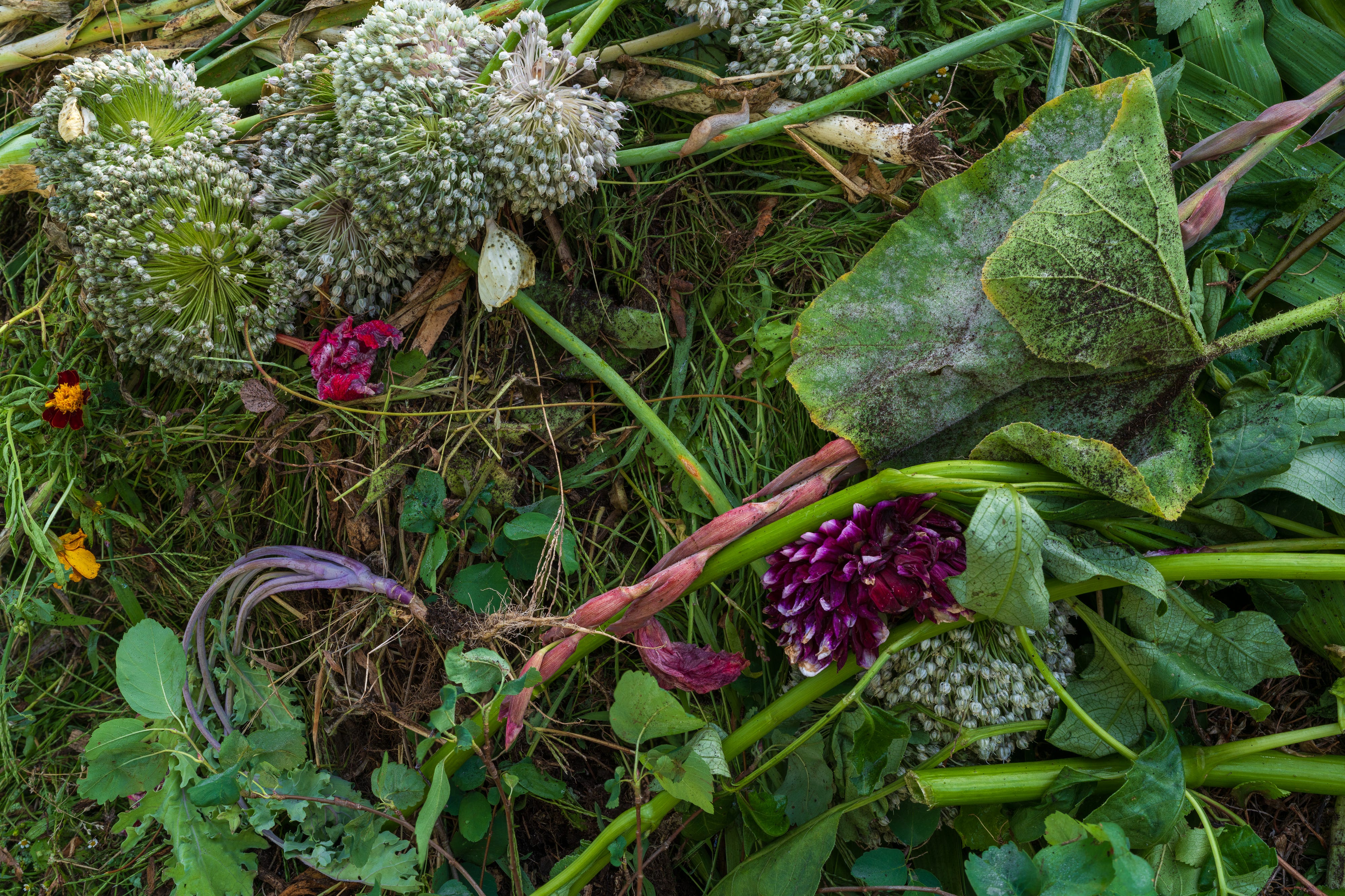
I started at the compost pile, which looked totally rotted and dead. And then the light hit the top of the pile, now maybe seven feet tall, steaming away. Still, I found two or three places where there was shadow protecting the pile from the brighter light. I took three images which, on one hand, excited me with their complexity, but on the other, seemed just too perfect, like still lifes. They seemed arranged. Finished, I was going to walk back to the car, but turned left and started walking across the garden instead. This decision led me somewhere else.
I took several photos as I walked. The first photo right after sunrise. A lot of the garden is protected from this harsh light until the sun finally comes over the hill to the east. What light did arrive was broken up by a mackerel sky, a cloud cover that scatters light without letting any one patch go brighter than its neighbour. The sky seemed painted, painted a colour that was almost rig. There is one shadow in the frame, cast by a tree in the upper left, and it’s the only place the image really seems to have a third dimension. Everywhere else, a wall of roses, fireweed, runner beans, and crocosmia runs unbroken from one edge of the frame to the other, closed off at the bottom by a single log laid down to edge the plant bed, and the whole thing reads as surface rather than space.
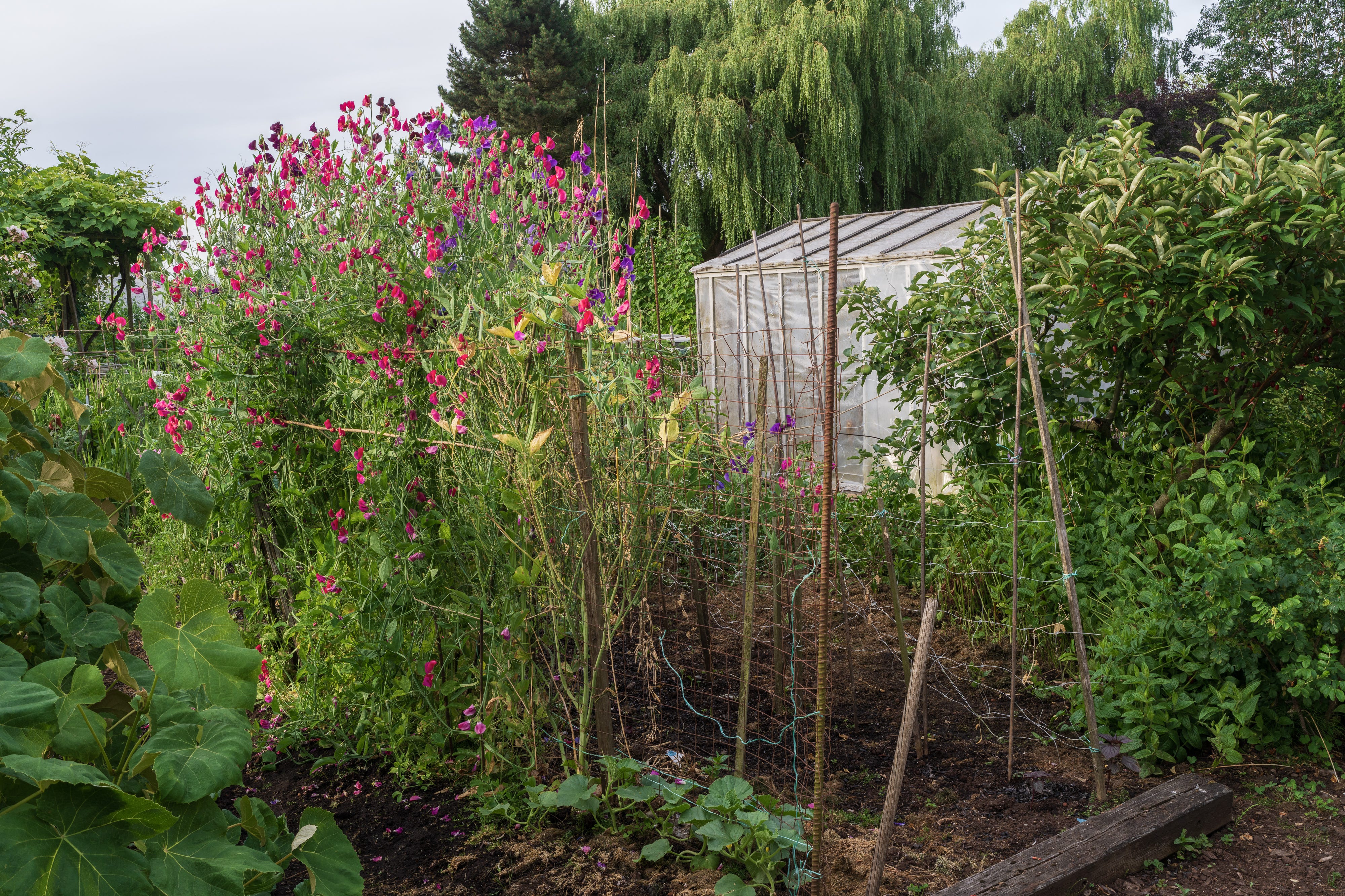
The other two photographs are different; they have real depth in them, measurable depth, the kind a lens can record. But that isn’t how they present. In the sweet pea photograph, the willow really has gone soft and pale behind the flowers, ordinary atmospheric perspective, and the canes really do converge toward a point behind them. The depth is genuinely there. It just isn’t what I see. What I see is the magenta of the sweet peas as one mass, the pale sky as another, the willow’s yellow-green as a third, colour sitting next to colour with no drawn line telling me which one is closer to me, the same way I’d see a more recent Larry Poons canvas, colour massed, one hue pressed right up against the next with no gap of bare ground or bare sky left to rest the eye. The third photograph, the tangle with the blue irrigation hose, doesn’t leave me even that argument. It fills itself top to bottom, edge to edge, with no sky at all and no horizon.
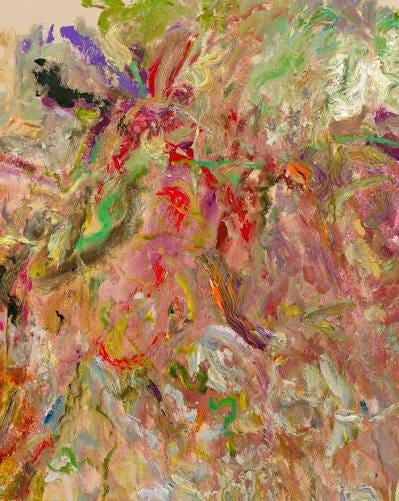
Looking at these images on the back of my camera, I saw them as tiny works by Larry Poons. Larry Poons’s name is usually attached to the dot paintings that made him famous after his first show at the Green Gallery in New York in the early 1960s, hard-edged coloured ellipses plotted on a grid against a single-colour ground, the colour contrast alone making the dots seem to drift and vibrate. In 1966 he broke with the critic Clement Greenberg’s formalism, the theory that had helped make him a success, and with the tedium of plotting every dot before touching paint to canvas. He started working with the canvas flat on the floor, then later tacked to a wall, throwing and skimming thick paint and letting gravity pull it into cascades, a method that by the early 1970s had become his “Throw” paintings. The change cost him. Buyers who had built collections around the dot paintings stopped buying, and dealers backed away, because he had been identified so completely with one style that abandoning it read, to the market, as a kind of professional suicide. He did it anyway. Asked later how much of the result was accident, he said close to all of it. What he’d actually done was hand the drawing over to a physical law with no aesthetic opinion of its own, gravity, and shrink his own role down to setting the conditions: how much paint, what sequence of colours, how hard and at what angle he threw.
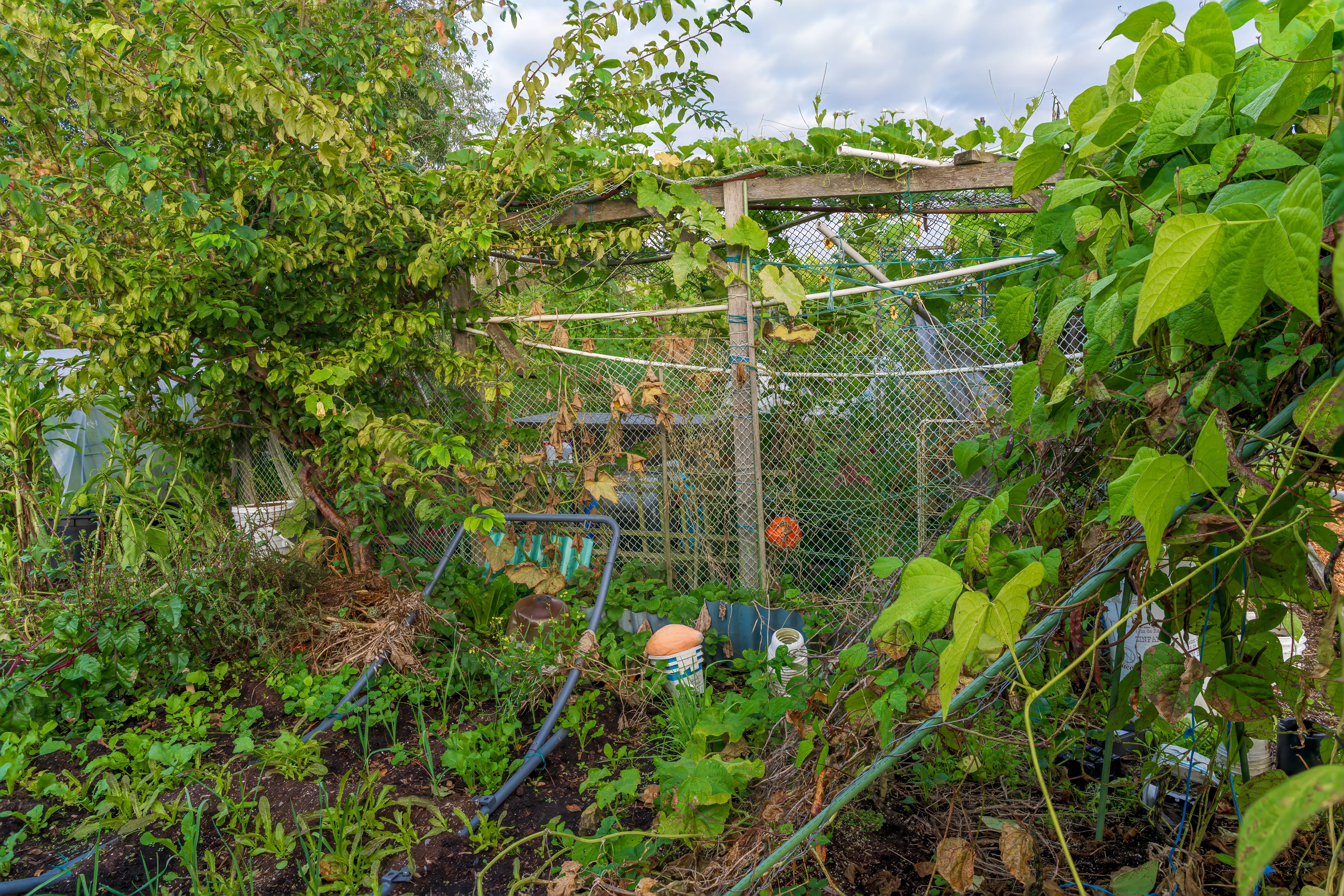
Gravity has no stake in where a drop of paint lands. It is genuinely indifferent, and that indifference is exactly what let Poons escape his own habits and get somewhere his hand alone would never have taken him. A plant is the opposite of indifferent. Every stem in that tangle is reaching toward light because reaching toward light is, for that plant, the entire difference between living and not living, and it’s doing that while crowded by a dozen other plants making the same claim on the same gap in the canopy. Nothing in my photos happened by chance. Every leaf is exactly where it is for a reason, even when the reason is invisible to me looking at the picture.
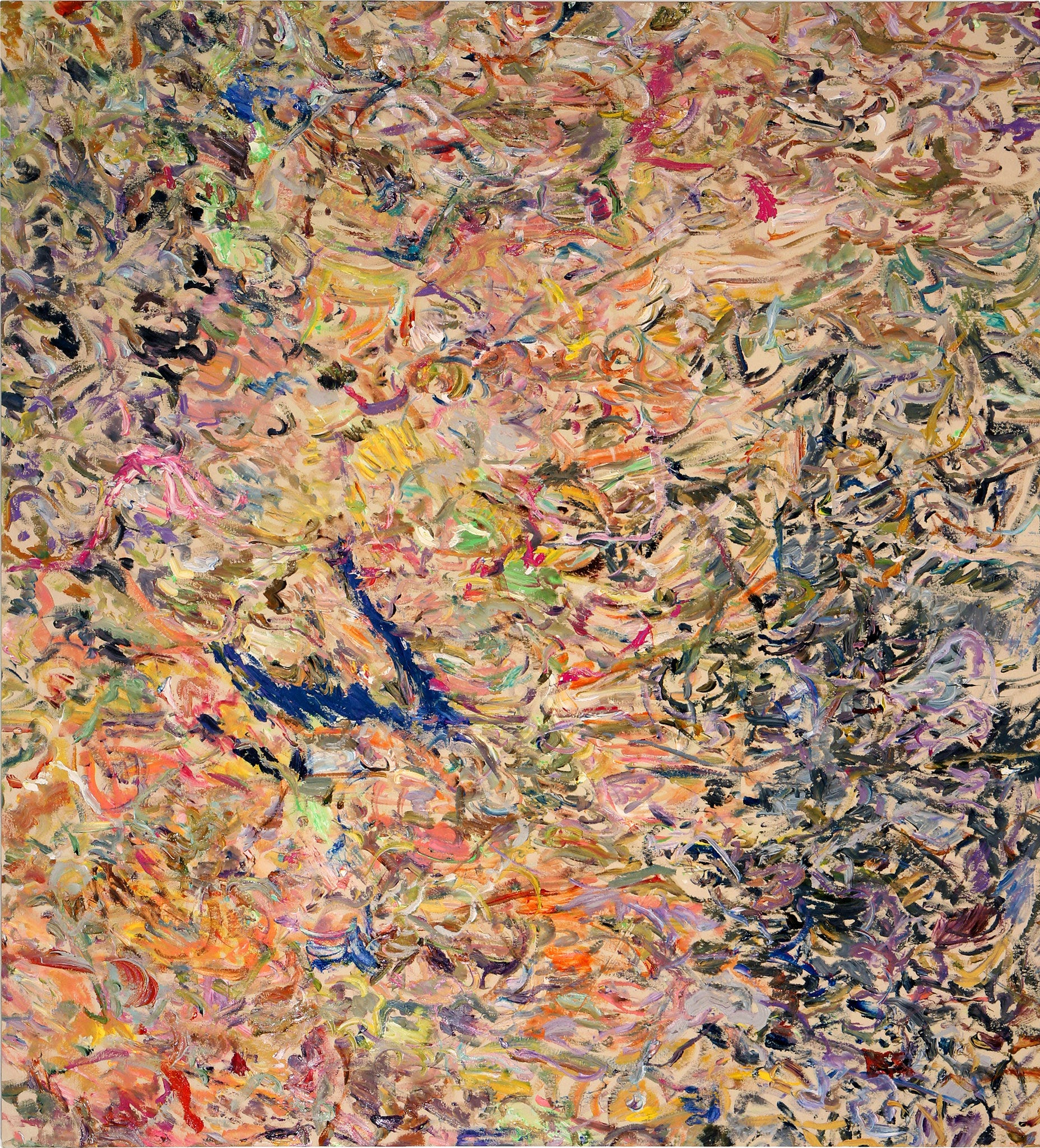
A Larry Poons Canvas
So the resemblance to Poons isn’t that the garden photos and the canvases were made the same way. They were made by opposite means. Poons reached formlessness by removing intention, letting a blind force take over from his hand. He was stepping away from overcontrolling his own work. There would be no more carefully measured dots for him. The garden reaches something that looks like formlessness by piling on so much intention, hundreds of individual plants each pursuing one single-minded reason, that no viewer can hold all those reasons in view at once, and what’s left once the reasons disappear from view is a field with no obvious hierarchy, the same kind of field Poons was after by throwing the paint away. Chance and its opposite arrive, from two different directions, at something that reads the same from where I’m standing with a camera.
Colour does this work on a different axis this time, temperature rather than structure. The two Poons canvases sit on a warm, pale tan ground, not white, not black, something closer to raw linen, and the colour that gets thrown against it, the pinks, the greens, the small hits of orange and blue, reads as saturated but never garish, because the ground underneath is doing the quiet work of softening everything laid over it. My own photographs are pastel for a more literal reason. The diffuse, shadowless light in the garden that morning, light that had already been broken up by cloud before it reached the beds, doesn’t just flatten depth; it desaturates colour, pulling what would be a hard, saturated red under midday sun into something closer to rose, and a hard magenta into something closer to mauve. Some dark red roses do, I admit, look like splattered paint fresh from the tube, randomly thrown against the image. I am fascinated that both surfaces, Poons’s canvas and my photographs, are pastel for reasons that have nothing to do with each other, one a ground colour chosen in a studio, one a lighting condition dictated by a hill and a cloud layer, and yet they land in roughly the same register. I keep looking, and comparing.
I didn’t set out to make photographs that answered to Poons, and I don’t think these three pictures are really responses to his work. The likeness showed up afterward. Every leaf in these three photographs is there for a reason: chasing light, crowding a neighbour out of a gap in the canopy. None of it is an accident the way a Poons drip is an accident. Chance made his colour fields. I haven’t learned to be that free yet.
Sources consulted:
You're welcome.
What a pleasure! Thank you