
Bad Weather
About Martin Parr

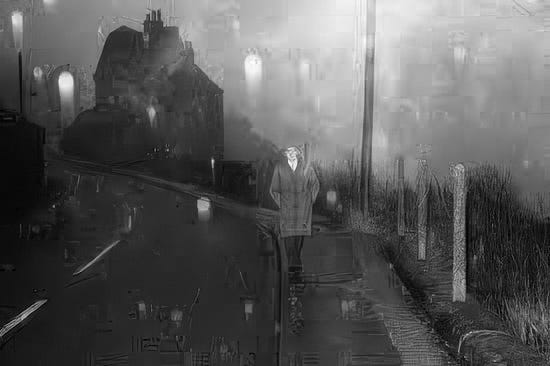
Martin Parr died yesterday. Over the years, people have debated his work from every angle, whether he was affectionate or satirical, generous or too knowing. Was he serious or joking? They had all sorts of questions, especially about his later (colour) work. But I never doubted that Martin Parr was a good photographer. An artist. A generous and caring person. If you have any doubts, go check out The Martin Parr Foundation. You’ll see why you should feel good about him.
For me, the practical reason I liked Martin Parr so much was seeing his first book, Bad Weather and that singular photo above. I have always thought of that series as Parr at his clearest. It sits before the Parr who became a cultural figure, before the saturated postcards of British leisure, before the queues of festival-goers and trays of humorous fluorescent desserts. Bad Weather was the first set of images of his I saw, and really, it contained the first images that opened my mind to what a “good photograph” could be. This one photo made me think about photography in a totally different way. Photos don’t have to be perfect. Photos don’t have to be loud, and photos don’t have to be easy. Not for the photographer, or the viewer.
The entire book seems to be about just rain, fog, dismal skies, wet bunting, and people trying to stay cheerful, making do with being damp, which is better than wet, when the day refuses to cooperate. A couple of pages in, we see a black-and-white photo of a man in a coat walking down a hill in the rain. You can barely see him; the rain seems to melt the image, especially the rain close to the lens, which, due to the slow speed of the shutter, makes a greater visual impact than the man himself does. The lens in this series is often wet and frequently has fog on it. But I recognized this image as a true wonder, something that showed me what I could not, and cannot, adequately describe in words. We feel something, something about the daily battle, the daily struggle we all know. This is what a photo is for. For me, it has an overwhelming emotional impact. I know these days when we struggle to stay damp rather than get wet.
I keep a small printout of this image in a drawer to remind me that this is what a good picture would look like. ‘This is your goal.”
When I think about Gerry Badger’s notion of the quiet photograph, Bad Weather is almost a perfect instance of photos that do just what Badger describes. There is nothing emphatic in it. No dramatic skies. No pattern of heroic light. The photographs don’t declare themselves as great photos; as a matter of fact, you could say they hide that fact. They are understated to the point of humility, which is precisely why they endure. Parr also shows us that photography doesn’t need the performance of craft to become meaningful. Although quietly, if not secretly, he knows his craft more than most, to the point that skill is camouflaged as casualness.
Parr was using a waterproof camera for this series, often with the flash on, which, in the rain, bounced off everything. He worked in conditions when most photographers would stop shooting. The negatives fogged, the contrast dropped, umbrellas passed too close to the lens, and nothing about the work is technically assertive. And yet: the photographs in this book register experience more faithfully than the polished black-and-white printing that dominated photography at the time. The photos don’t simplify the world. They withstand it. They tolerate the situation. Yes, this is Britton, carry on.
It’s important to remember that when this book appeared, British photography, particularly documentary work, was still anchored to seriousness and clarity. People still took McCullin and the earnest social-realist tradition of documentary photography as a standard. Darkrooms were full of immaculate prints, careful dodging and burning, and photographers believed, quite sincerely, that excellence required virtuoso precision. Into that landscape, Parr released a book photographed largely in drizzle, fog, poor lighting, and people quietly struggling with the mundane things that make a life.
Some photographers admired Parr’s refusal of theatrics. Others thought his work lacked ambition. Critics were slow to see it clearly. Reviews called the work “amusing” and “modest” as if those were limits rather than decisions. Later, of course, after The Last Resort and Small World, people could see the foundation beneath the irony and recognize that Bad Weather was not incidental at all. It was the beginning of Parr’s lifelong position: that ordinary life is both fragile and resilient, and that culture reveals itself most clearly when nothing significant is happening.
What strikes me is how Bad Weather treats mild inconvenience as worthy of notice. It’s not a catastrophe. It’s not a spectacle. It’s the weather that erodes enthusiasm rather than endangers life. People stand under umbrellas drinking tea. A damp folding chair sags. Someone waits for something that will probably not happen. It isn’t tragic, it’s simply life entering a state of diminished expectation. And because the images stay neutral, never sentimental, never judgmental, they turn resignation into a kind of shared condition.
This is where the book becomes deeply quiet, in Gerry Badger’s sense. Not quiet emotionally, but quiet in posture. It never raises its voice. It never tells you what to feel. It lets meaning emerge through repetition and accumulation: the way gloom settles, the way people persist.
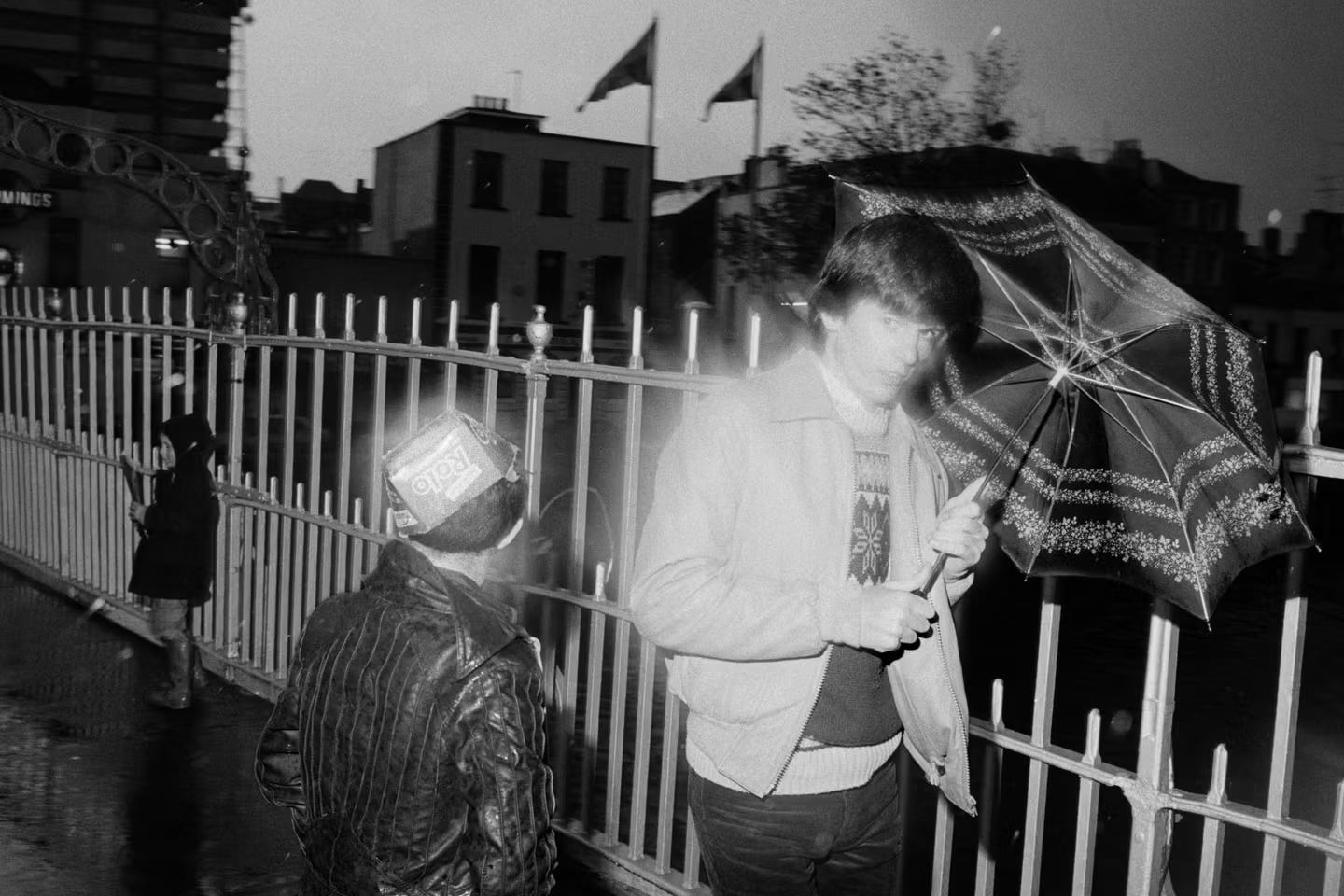
When people remember Parr, they will mention what came later: the global tourism pictures, the holiday satire, the commercial presence, and the ubiquity. But for me, Bad Weather remains his most unguarded achievement. It was early enough that he still trusted looking more than commentary. He had not yet learned to decorate the world; he just endured it.
Bad Weather is not a heroic vision. It is simply attentive. It notices what everyone else rushes past. That’s the great, quiet trick of the book, and perhaps the reason it still matters, especially today. Thank you, Martin Parr.
For a good look at the book Bad Weather, click here: Bad Weather Video
For some stills of Bad weather, check out Martin Parr’s web page here: Martin Parr
Thanks for reading. You can help by subscribing, leaving comments, sharing, and, if you publish on Substack, recommending my stack. Join the conversation, I’d love to know what you think of Martin Parr’s work, especially if you weren’t familiar with the early monochrome images.
My work can be found on my website at www.jimroche.ca
Bad Weather is my go-to when it comes to Parr, and a book I hope they rerelease one day so I can get a copy (or perhaps I'll find a good used one somewhere). I have nothing to add to this excellent little write-up, thank you, and that's all, to Martin.
I remember seeing The Non-Conformists exhibited at Compton Verney just after the book was printed, a decade or so ago, wondering why I hadn’t seen this side of him before: when he was still so young, but so obviously massively naturally gifted. It is my favourite work of his (and he kindly signed my copy… – always, when not working, generous with his time: quizzing me gently on my favourite image, the man with one foot on the ladder in his suit and hat…). Not that he ever went downhill, just that his focus shifted.
Bad Weather is close behind; and I seem to be in a majority here of the photographers who prefer his black-and-white work. But, whatever your feelings on the later colour stuff, there is no doubt in my mind that he was a great photographer all of his life; and that he used that talent to do so much for us all (especially the Foundation): knowing that, one day, he would have to let go.
His influence, I am sure, will reverberate around the planet for as long as there is photography; and for that I am grateful. A great man. And missed so much already, and by so many.
Thank you, Martin.