
About Writing Descriptions
The Trees and Park

Besides notes and comments from readers about the content of my essays, I get a lot of emails asking about my writing process, about writing descriptions. I’m not an expert at writing descriptions, but I am practicing it. I started a writing practice a few months ago that seems to be helping me. Let me tell you about it, because I think it also helps my photography.
Every day I go to eat breakfast at McDonald’s. There, every day, with my noise-cancelling earphones on, I read one short story by Chekov from Anton Chekov, Fifty-Two Stories, translated by Pevear and Volokhonsky, and make a quick outline. Just 4-5 lines. I pay particular attention to how the story starts -the first sentence- and how it ends, the last. I also reread a number of the books I assigned to my students who were having trouble writing, and dug out my copy of a very useful book, “Writing for Story,” about non-fiction narrative writing by Jon Franklin. The best book for a non-fiction narrative writer that tells you how to create a piece people will want to read. I also bought a new copy of On Writing Well by William Zinsser and reread that, , and I try to read one interview every few days by Jarrett Earnest from What It Means to Write About Art. Lately I have also read The Elements of Eloquence by Mark Forsyth and George Saunders’ A Swim in a Pond in the Rain. I found that to be a lot to read, so I have both the book and the audiobook to listen to. I read art reviews in The Atlantic, Art Forum, The New York Times, and anything by Dave Hickey I can find. Oh, and every morning, on my way home from McDonald’s, I pay attention. I watch people, I study the street, the sky, everything. While at McDonald’s, I often watch one person for an extended time, and when I get home, write everything I can remember about the person and the walk. Oh, and I listen to and read anything Helen Molesworth, the art historian, gallerist and art critic, says or writes.
I think my writing is still….well, just OK, but writing is the number one thing that helps me understand my art, and focus my photos. If you want to be an artist, I urge you to develop a writing process and make it a habit.
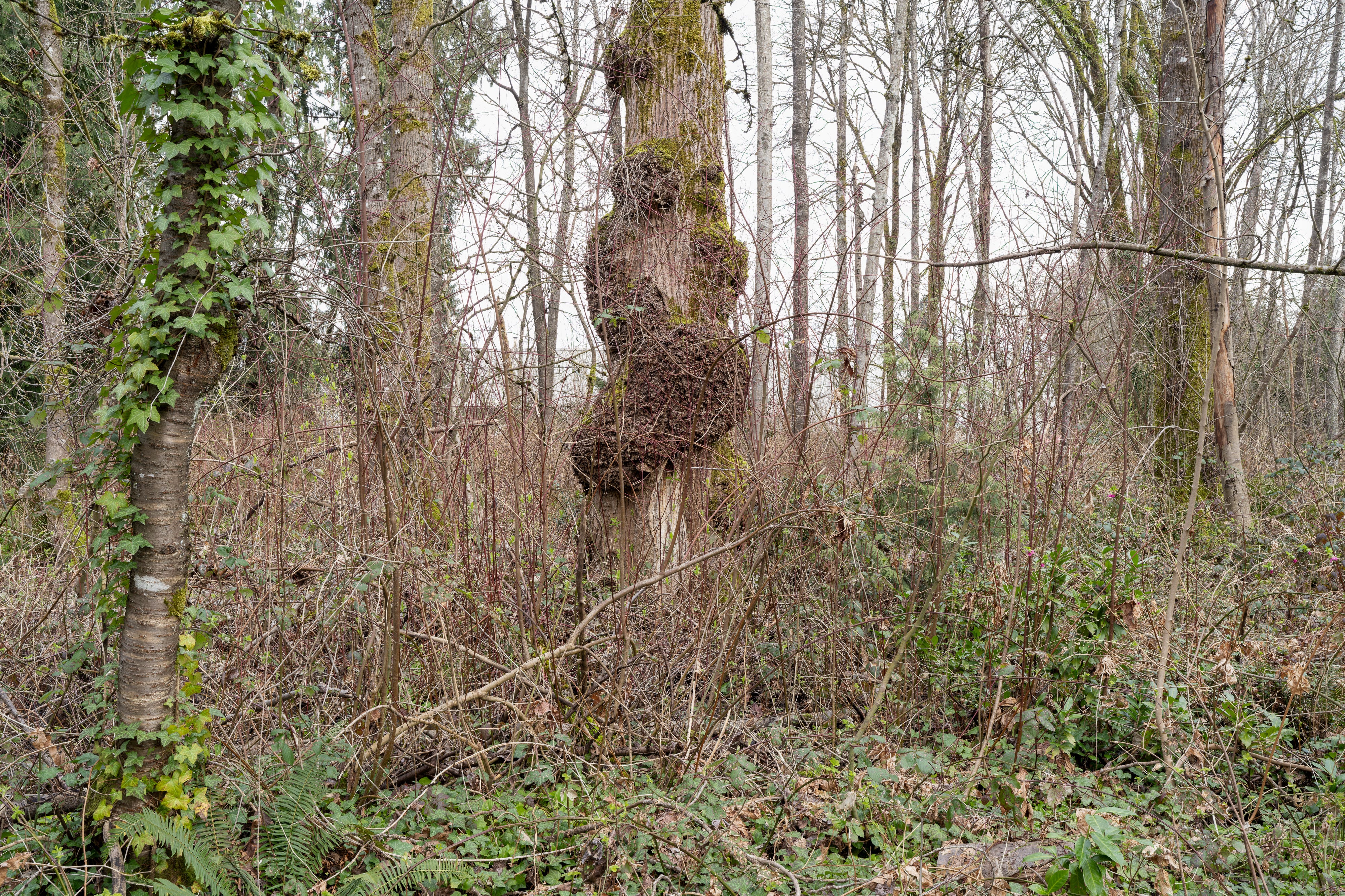
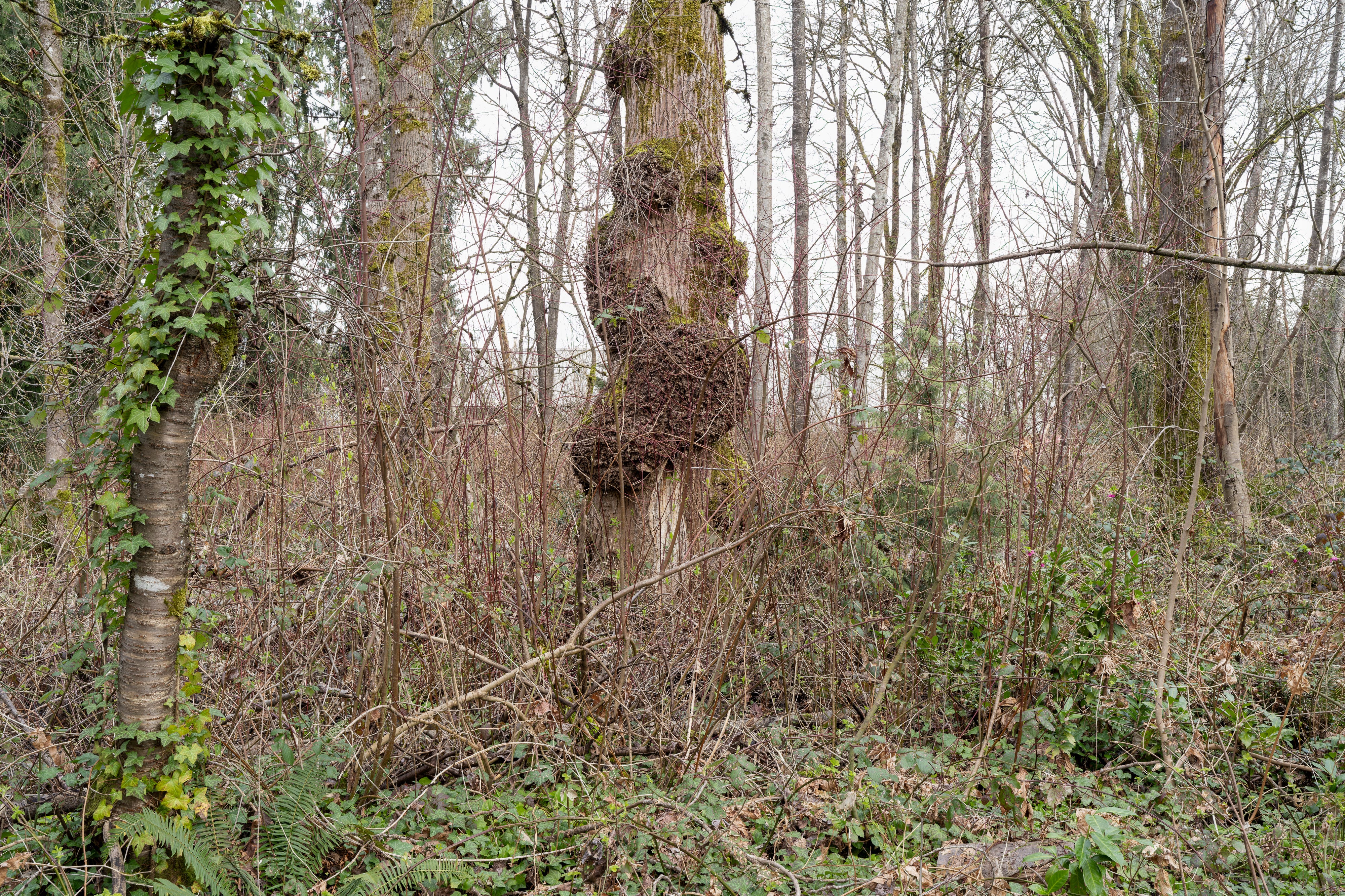
So here is my long description of the image above, and another copy of the image for you to refer to. I hope you enjoy it.
THE TREES AND PARK
This image, similar to much of what I’m taking lately, is of a dense patch of urban woodland on top of a hill. Right now it’s dry, but in the rainy season it can become almost marsh-like. It’s taken in a Vancouver urban park surrounded on two sides by houses, only barely visible here behind a fence in the background, and a golf course on another. The houses and fencing are hard to see, but once you know they are there, you sense them easily. What is left of the woodland forms a screen during the late fall through early spring, and then becomes quite impenetrable. It becomes a wall. The lay of the land initially takes a slow downward curve, then rapidly drops down to a major street, and finally into the floodplain of the Fraser River. The image is dominated by a large central tree trunk covered with burls, moss, and accumulated growths that have distorted its shape over decades. This is what originally drew my eye, and it remains central to the image. Around it stands a thicket of young deciduous trees, bare branches, vines, brambles, and undergrowth. To the left, a smaller tree is wrapped in ivy, its vertical form echoing the larger trunk nearby.
The light is soft and overcast, typical of the Pacific Northwest. There are no dramatic shadows or highlights. The palette is restrained: muted browns, grays, pale greens, and touches of fresh spring growth emerging through last year’s dead vegetation. Ferns occupy the lower foreground, while the background dissolves into a mesh of slender trunks, saplings, and branches. The photograph is quiet and observational. There is no obvious focal event beyond the peculiar central tree and no sign of human presence, even though the image was made within a city park surrounded by single-family homes. Behind me are several pathways, all leading in very different directions, some edged by young trees, others by grasses, and some by ivy-covered trees and the invasive berry bush you see almost everywhere, Himalayan blackberry (Rubus armeniacus). Their thorns make leaving the pathways impossible. I usually carry a clipper to open a pathway or the view I might want to photograph. Despite the name, it is actually native to Armenia and northern Iran, and was introduced as a fruit crop before escaping cultivation. Often groups of volunteers are seen, pruning back these bushes that form dense, thorny thickets along roadsides, streambanks, forest edges, vacant lots, and urban parks. Small songbirds, however, fly through these thickets as if they were invisible, darting faster than you can follow them. They move too fast most days to be identified by anything but their calls and chirps.
What immediately distinguishes this image, why I like it and try to make more like it, is its refusal to be picturesque. Rather than isolating a majestic tree or arranging nature into a clear composition, the photograph accepts the woodland as it is: tangled, crowded, and always, to varying degrees, visually resistant. You have to work to understand what you see.
The central tree acts as an anchor, but this anchor is partly obscured by vines and brush. The eye moves between foreground, middle ground, and background without settling. Nothing is really noticed in full all at once. You create what order you can by engaging for a longer time than you would normally give this view. The image doesn’t tell you where to look, which is something I find increasingly important. It recalls, for me, the later work of Robert Adams, his forest photographs, where the complexity of an ordinary woodland becomes the subject itself rather than a backdrop for scenic beauty. What’s available to the eye, and the camera, is landscape as a place of accumulation rather than spectacle. You find yourself aware of processes rather than moments: growth, decay, competition for light, colonization by ivy, the formation of burls, the continual regeneration of the forest floor.
For me, a particularly interesting tension is that this appears wild while actually being urban. That tension runs through a lot of landscape photography since the 1970s, and it’s something I think about as I walk through here. The photograph doesn’t present nature as separate from civilization. Instead, it shows a managed city park that has been allowed time to develop its own ecological complexity. This was, years ago, a deep forest of large old-growth trees, but that time has passed. The result is a landscape that feels both neglected and thriving.
I try to use neutral, descriptive framing. No dramatic weather or theatrical light. The subjects are ordinary rather than exceptional. If I’m lucky, I can pay attention to ecological and historical processes without them taking over the frame. I’m not interested in nostalgia. And here’s something I’ve been verbalizing more lately: I try to make an image that feels like observation rather than expression.
I prefer cloudy days. The overcast light is crucial. Bright sunlight would simplify the scene by creating dominant contrasts and visual hierarchies. Diffuse light allows every branch, vine, and texture to remain visible. Sometimes I use photostacking to do that, so it’s unlikely I will be out when there is much wind, or you will find me sitting next to my tripod, waiting, and waiting for a moment of calm. The photograph becomes an inventory of relationships rather than a statement about a single object.
That’s it, I find writing about art, including my own work, helpful in understanding it, and focusing my photographic process. Understanding why I do what I do. Try taking a single image and writing about it. FYI: This essay was originally twice as long. The first edit removed 30 percent or more, and subsequent edits, especially the last edit, finally got it down to 50 percent. There were eight comprehensive edits in all. Usually, when editing, I read what I write out loud.
If you write, I’d love to hear about your process.
I admire your writing about a single image so detailed and am inspired to try it myself, because I believe you that it has an effect on your own photography.
Your practice reminds me of dream journaling. Every detail matters, so each morning, as I journal my dreams, I describe the time and setting for each dream. E.g., "It's just after sunset, and the clouds are painted mauve and orange. I'm standing by a white stucco American Foursquare house with a large overgrown lawn edged by mature trees."
As you do, I try to use neutral, descriptive framing. I think it does help my photography.